King of Bling
Jewels at court
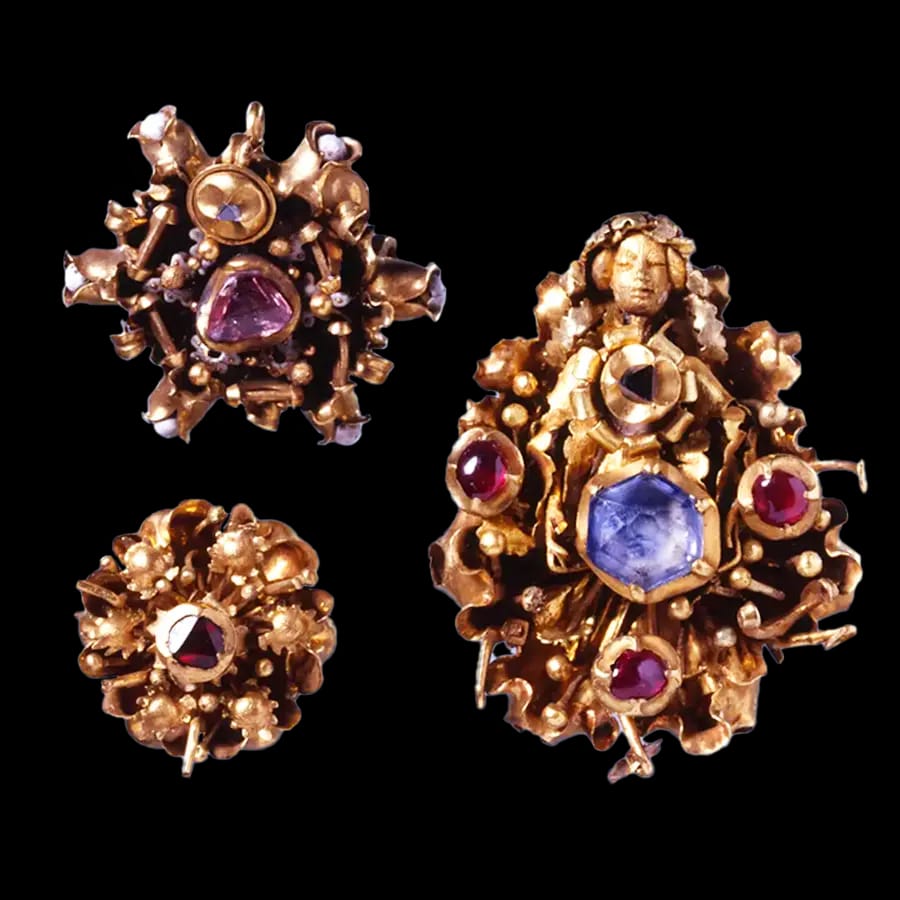
Jewels were an integral part of the presentation and performance of majesty at the Burgundian court.
Precious gems were a key element of self-fashioning for the opulent Burgundian dukes. Adorning their bodies with the most fabulous gems enabled the dukes to glitter with an almost divine aura that was unparalleled. The Three Brothers, commissioned by Philip the Bold in 1398, incorporated large and incredibly expensive stones into a new style of relatively simple design without excessive metal settings. This showcased the polished stones and allowed them - and their wearer - to shine even more brightly, especially when paired against a backdrop of clothes and wall hangings woven from cloth of gold.
Jewels such as the ‘Drei Brüder’ thus lent the dukes an aura not only of virtue, but simultaneously of wealth and power.
Heirlooms that are the “marvel of Christendom”
The elegant new forms of the spectacular Burgundian jewels, such as the ‘Drei Brüder,’ were passed down as heirlooms across generations.
Famous pieces of jewelry, set with the most costly stones, often had their own names — as did the ‘Three Brothers.’ Such jewels appear frequently in portraits of the Burgundian dukes, thereby linking splendor with dynasty. Although the ‘Three Brothers’ does not appear in any of these portraits, archival records and inventories attest to its extraordinary value. The piece of jewelry was made on commission in 1398 (as recorded in Burgundian court records) by the Parisian goldsmith Hermann Ruissel for Charles’ great grandfather Philip the Bold, and later was included in the inventory of his grandfather John the Fearless.
A Financial Windfall for Basel?
The secret matter of the looted jewels
Booty was an integral part of the pre-modern war economy: it generated funds to pay soldiers who had fought in a war. After Grandson, the city of Basel managed to conceal the fact that they had taken possession of Charles the Bold’s great jewels - which they proceeded to sell secretly to raise money.
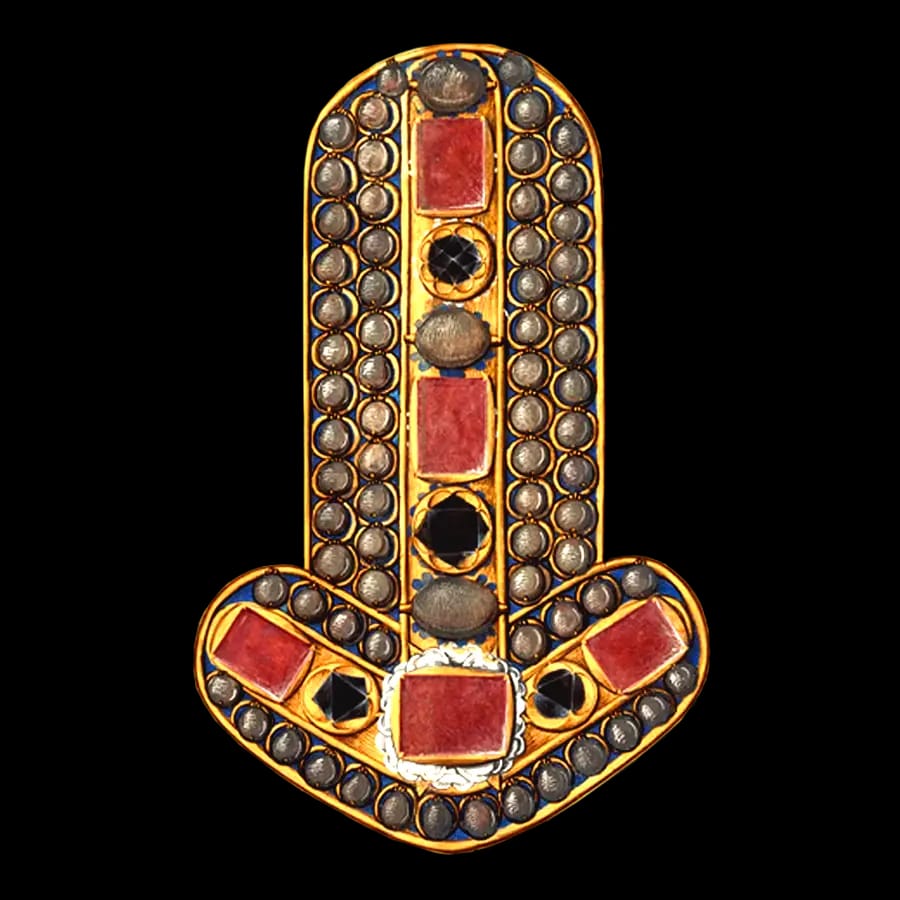
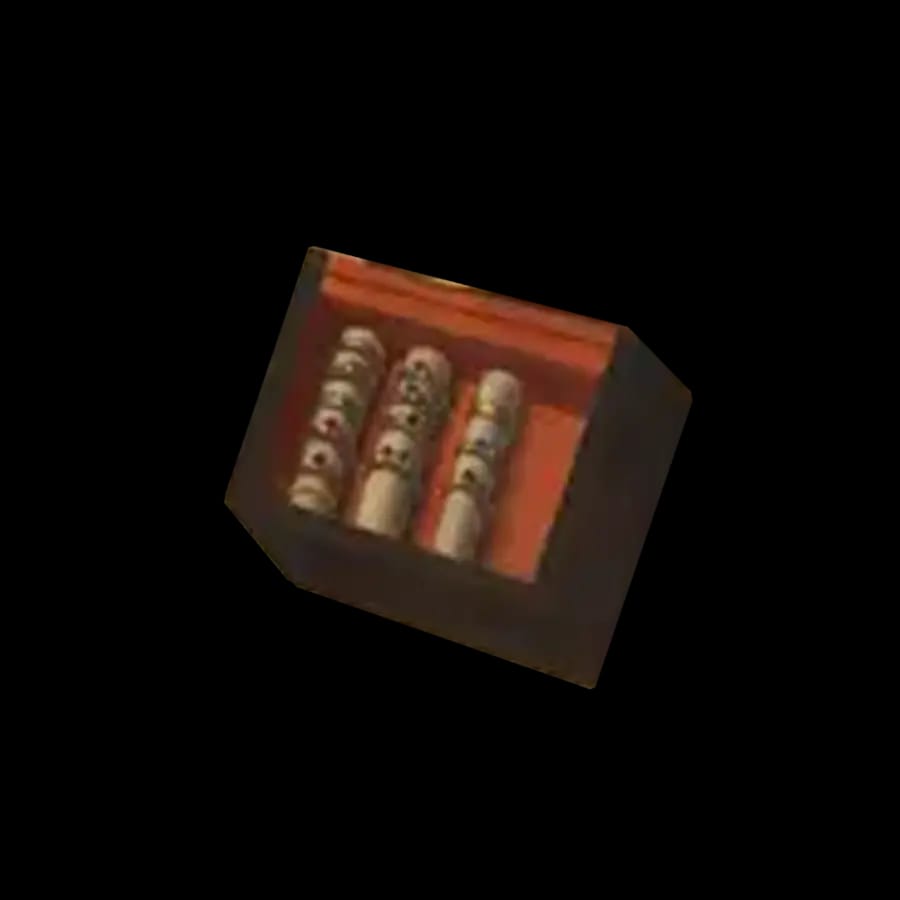
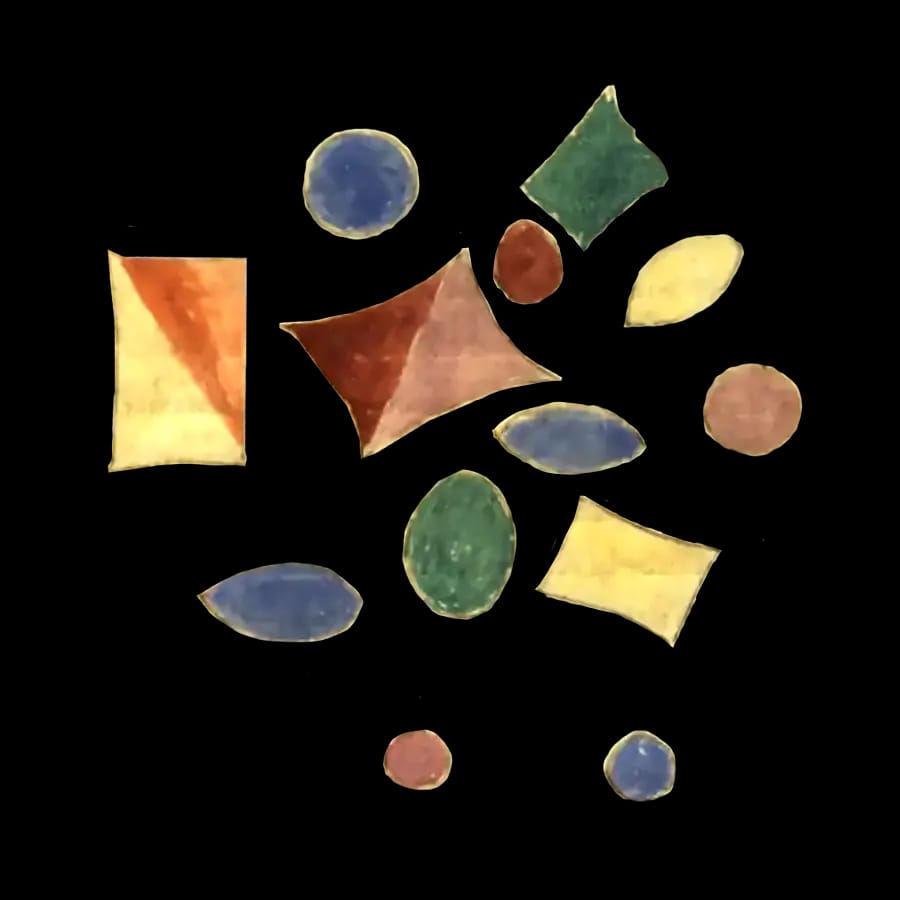
In 1502, Basel’s magistrates decided to sell the jewels that they had pocketed in Grandson, including the Three Brothers, in order to raise funds for the city. They kept the sale of the Duke’s jewels a secret so as not to anger the other Eidgenossen. The file in the city archives sports a cover that reads “the secret affair”. A certain Hanns Walther from Wurms, who lived in Venice, evaluated the precious jewels for the city and the magistrates had lifesize watercolors made in order to attract potential buyers, which is how we know how the jewels looked today. The drawings take care to enhance the sparkly nature of the gems, which are further renered appealing through the use of flat planes of background color as well as highlights and shadows that convey the stones’ volumes. By 1504, a buyer was found in Jacob Fugger (“the rich”) and his brothers, who paid a hefty 40,700 Gulden. An interest in the jewels remained lively in Basel, and we find them still discussed in the Basel merchant Andreas Ryff’s late 16th-century coin and mineral treatise. Monetizing loot was part of the traditional practice of taking booty and redistributing it into local late-medieval economies.
Life-sized watercolors of the jewels were made in order to attract buyers. Thanks to these drawings, we know today what the jewels looked like.
In 1504, Jakob Fugger (‘the Rich’) and his brothers purchased the Burgundian jewels from Basel for a whopping 40,700 guilders.
A deal concealed
Basel deliberately kept the sale of the jewels secret.
Basel kept its role in the sale of the jewels secret for centuries. The details were, in fact, well documented — but the records were kept hidden away in the city archives. Indeed, the sales drawings were made so that the jewels themselves could remain under wraps in city hall.
The gap in the historical record — and Basel’s role in the trade of Charles the Bold’s precious jewels — remained hidden until historians in the 19th century discovered the documents, and later also the drawings that had been made for the sale of the gemstones. In this way, a gap in the historical record was artificially created and maintained until the 19th century.
In the Basel archive, however, lists (including a ‘Beuterödel’ [booty ledger]) can still be found, in which the booty from Grandson was recorded and distributed. There we find, for example, a silver bowl with an estimated value:
“koufflüt[…]Conrat scherer von örenstetten[…] doruf hetEr gelöset iii gulden und hetUs silber gelöset iii lb [liber] desHet er sins einen gelz uspiltVii lb”Merchants
[…]
Conrat Scherer of Örenstetten
[…] thereupon
He received 3 guilders, and had
Redeemed, from silver, 3 pounds, of which
He paid out one portion in cash
7 pounds”
Basel’s governors also kept detailed lists of their expenditures during the Burgundian Wars. The sums were high. The sale of Charles the Bold’s jewels, as well as the distribution of booty among the guilds and individual citizens of the city, were an integral part of the wartime economy, yet those objects do not appear in the ledgers with the rest of the booty haul.
Augmenting Aura in Augsburg
Inventing Heirlooms
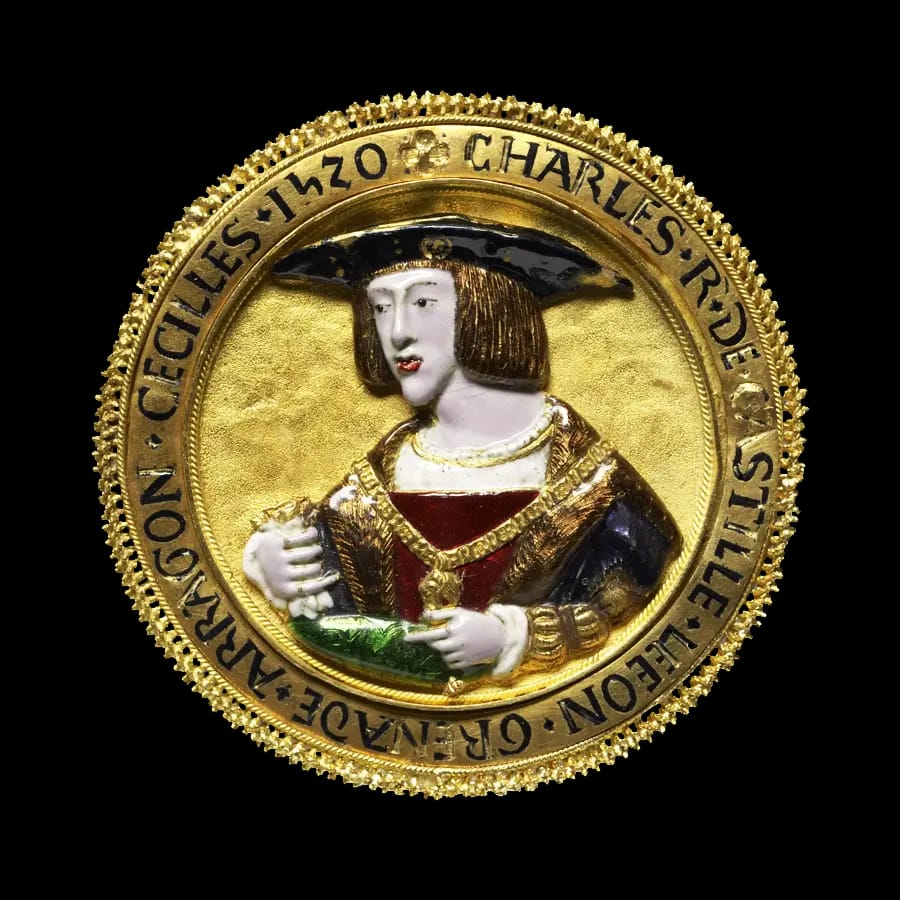
The fabulously wealthy Fugger family had bought Charles the Bold’s jewels from the city of Basel as a monetary investment, but to sell them they pitched the jewels as family heirlooms to the Habsburg family, drawing out a romantic royal pedigree.
The Fuggers invested an enormous sum in purchasing Charles the Bold’s jewels, doubtless because they assumed they would make a profit. Their ideal clients were the Habsburgs. Charles’ daughter Mary of Burgundy had married Maximilian von Habsburg. Mary died young which meant that her heirlooms, logically, would pass to the Habsburg family. In 1513, after years of negotiations, the Habsburgs agreed to purchase only two of the jewels. They did not buy the Three Brothers.
Yet in 1555, the Fugger family commissioned a magnificent manuscript to the honor of the Habsburgs, tracing the royal history and genealogy. In the manuscript, known as the “Ehrenspiegel des Haus Österreichs” (Honorable Mirror of the Austrian Monarchy), the Fuggers trace the provenance of Charles’ jewels, however, noting that the Three Brothers had ultimately been sold to the King of England. In doing so, however, the Fuggers emphasized the auratic value of royal jewels, rather than their financial worth.
Jewelry like hat jewels and chains drew attention to the face of the head of state. The ‘Drei Brüder’ could be worn either as a hat ornament or as a pendant on a necklace.
Copious copies
The Fugger family of Augsburg designed the illustrated text known as the Ehrenspiegel (‘Mirror of Honnor’) as a form of praise (and flattery) to the Habsburg dynasty. The drawings in the book featured family heirlooms. Some of these derived from the secret Basel jewelry sale images.
The jewels of Charles the Bold, captured at Grandson and Murten, are known today only thanks to the sales drawings. These were produced by the people of Basel in order to persuade the Augsburg merchant family Fugger to purchase them at exorbitant prices. The drawing of the ‘Drei Brüder’ was subsequently copied onto parchment for a draft of the Ehrenspiegel. In a revised version of this work honoring the Habsburgs, the drawing was copied yet again. In this way, in connection with the jewel sale, a chain of copies emerged, multiplying ever further. If it hadn’t been for the somewhat dubious Basel sale, we would no longer have a clear picture of how the Burgundian jewels looked. Copies were what preserved them for posterity.
Heirlooms at the English Court
Securing splendor for all genders
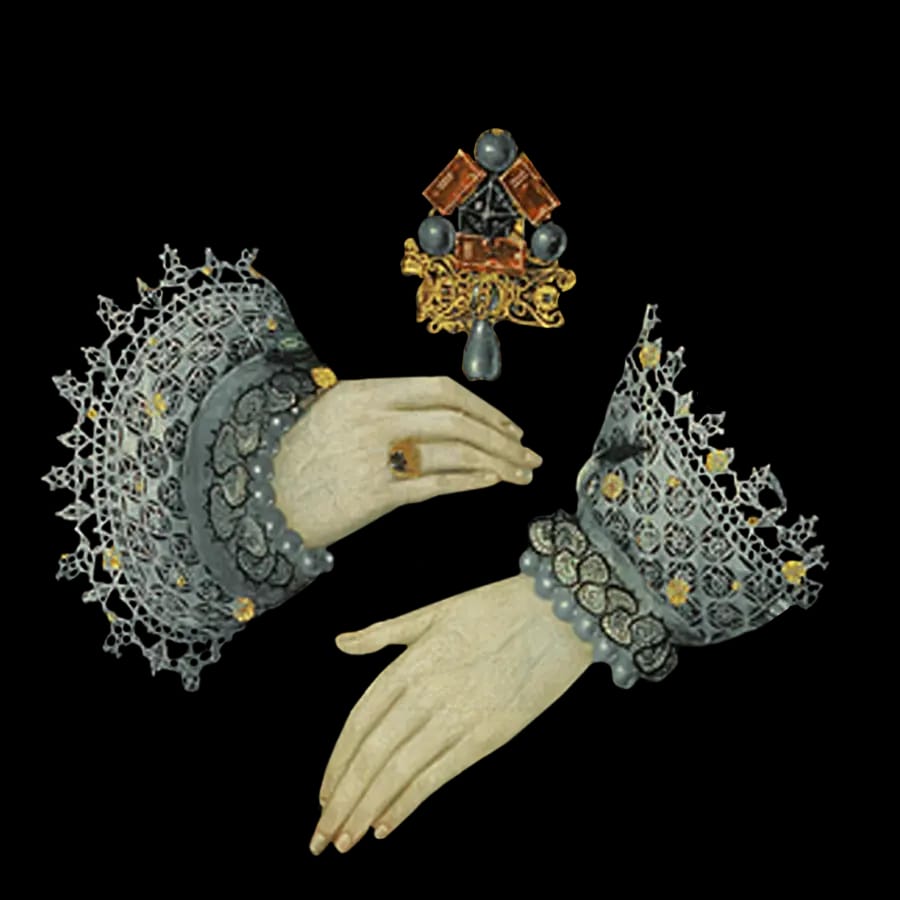
The ‘Three Brothers’ passed into the possession of the English crown, where it became a symbol of Tudor royal house — worn by both queens and kings.
At the English court, the wearing of lavish jewels served to display royal splendor. Henry VIII was famous for his passion for magnificent gemstones — a taste he passed on to his children. Edward VI acquired the ‘Three Brothers’ and brought it to England. Records show it then passed to “Bloody” Mary Tudor. Elizabeth I then had herself portrayed with the jewel on several occasions. Later, the jewel also appears in portraits of James I, who inherited it from Elizabeth. Wearing this piece of jewelry now underscored the wealth and continuity of the English crown, as the Tudor dynasty gave way to the Stewart.
Pawning and Redeeming
During the English Civil War, Charles I and his wife Henrietta Maria twice attempted to sell the Burgundian jewel.
In 1649, Charles I lost his crown and his life.
Even before this, the piece had already disappeared for a time on occasion: in 1625, it was pawned and later redeemed. It was not unusual for monarchs to pawn their jewelry. In 1642, Queen Henrietta Maria brought the ‘Three Brothers’ to the continent in order to sell it to raise money for her husband’s forces.
In The Hague, she found no buyer, and returned to London with the jewel. At the English court, the jewel carried symbolic significance — as an heirloom and as an amplifier of the aura of the crown. At the pawnbroker’s and on the market, however, this very history made the sale difficult: it was regarded as a ‘hot’ object. Would the crown want it back, eventually? Would a new English state claim the jewel as part of English heritage?
Inheritance Lost
In the course of the English Civil War, Charles and Henrietta Maria attempted to sell the jewel, and in 1645 it disappeared: a material and historical gap opened.
When things looked bleak for the English royal house in 1644, Henrietta Maria fled to Paris and there handed the jewel over to the Dutch merchants Thomas Cletcher and Joachim de Wiquefort. The last traces are found in letters from the queen’s circle, attesting to its being in the possession of these merchants. She never bought it back. In 1645, the trail of the ‘Drei Brüder’ went cold — the jewel was likely broken apart, reset, and sold in pieces.
Stolen Jewels on Display?
Exhibiting Absence
The legendary Burgundian jewels, among them the ‘Drei Brüder,’ have disappeared. How can a history of this lost heritage be exhibited today?
“The history of Charles’s jewels is one full of splendor, secrets, desire, and loss. Today, most of his precious objects no longer exist — they were plundered, pawned, broken apart, or sold. We know them only through reproductions, or copies, some of which were made (paradoxically) in order to keep the jewels hidden, like the drawings in Basel’s historical museum. How, can this history of loss still be shown? Historical and contemporary reproductions could makethis lost heritage tangible — yet the material gap can never truly be filled. The “real thing” is missing.
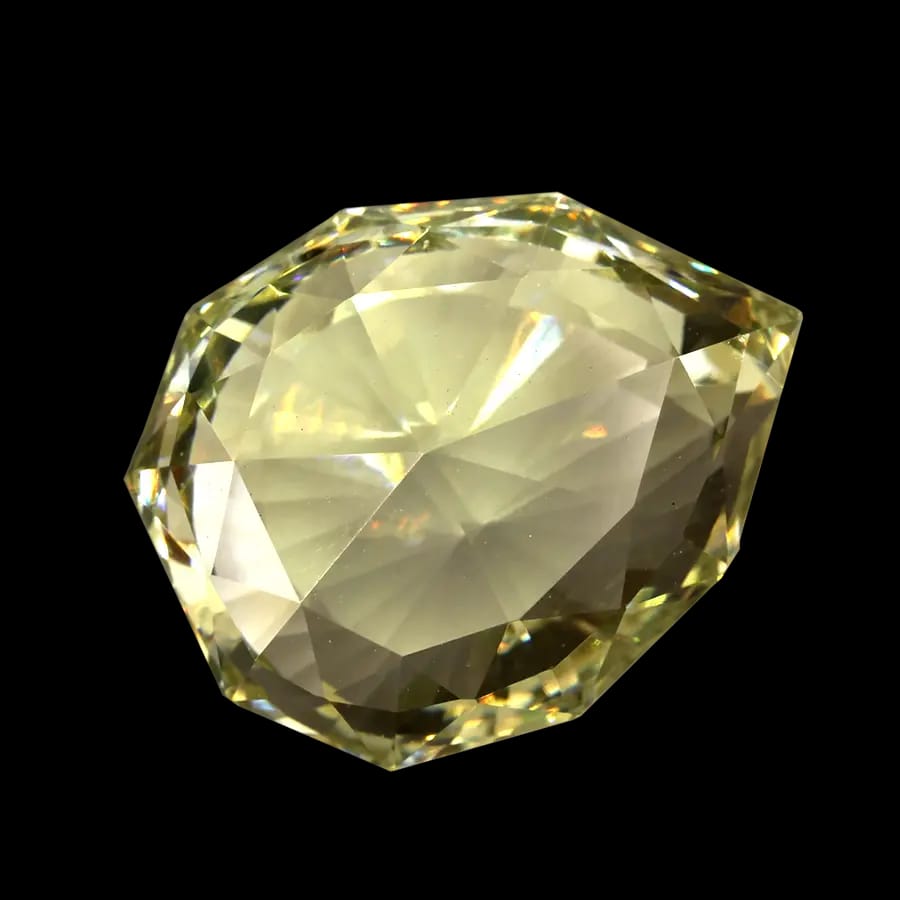
In the 19th century, Viennese mineralogists produced a plaster cast of the ‘Florentine’ diamond. This could be measured and compared with other large diamonds, such as the famous Koh-i-Noor diamond, which the English had brought from India. A Parisian glass artist created the copy now on display at the Natural History Museum in Vienna, using the plaster cast as his model. In Vienna museum, the stone is displayed as a marvel of natural history, rather than a dynastic symbol.
A reproduction of the Three Brothers was added in the 1970s to Queen Elizabeth 1’st tomb, in order to enhance the impression of authenticity.
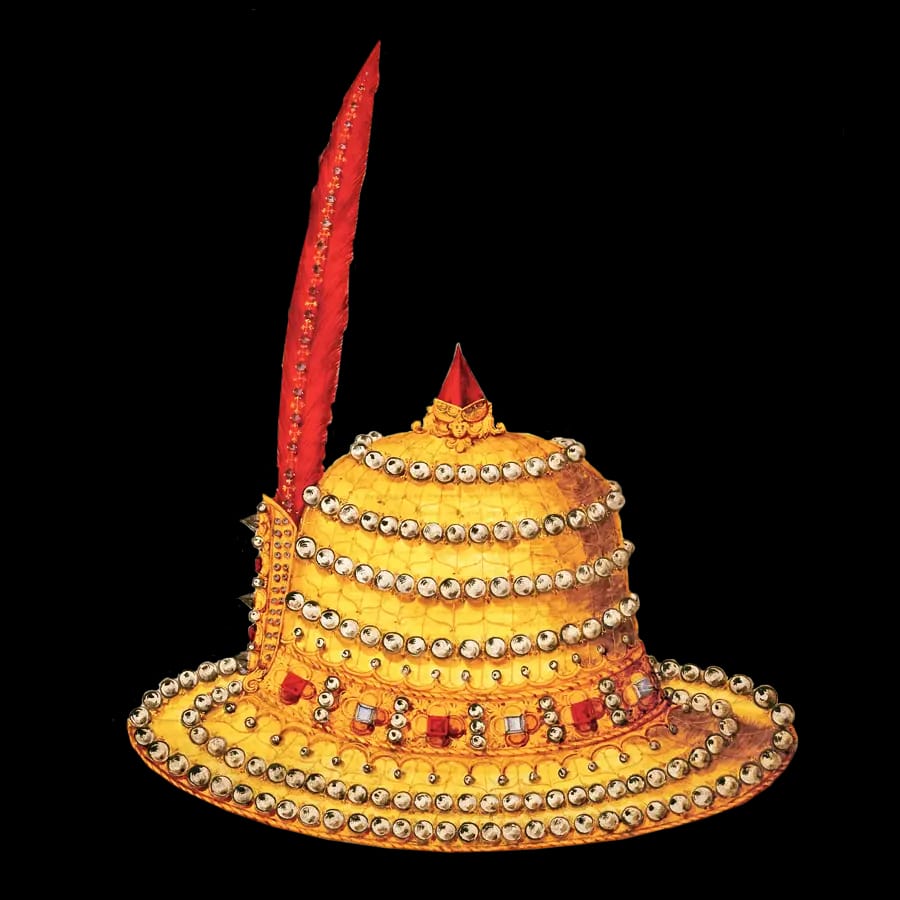
Charles the Bold’s golden hat, too, exists today only as a copy — can the Burgundian splendor be conveyed through these types of replicas?
Lost treasures recovered
A cache of supposedly lost Habsburg jewels — including the famed ‘Florentine’ diamond — resurfaced in 2025 in a Canadian bank.
In November 2025, a diamond long presumed lost, once belonging to Charles the Bold, suddenly resurfaced in a Canadian bank: the ‘Florentine’ diamond. The jewel had come a circuitous route from the battlefield of Grandson, to Italy, and finally to Vienna in the 18th century. Following his abdication in 1918, the last Habsburg Emperor went into exile — first to Switzerland. It was long thought that he had tried to sell the jewel through Swiss dealers who had absconded with it. The loss, however, was faked: having moved to Canada, the former Habsburg Empress Zita hid several precious jewels, including the ‘Florentine,’ in a bank. Their children had sworn to keep the secret for 100 years. Now the lost stone has resurfaced. But to whom should it belong — the family, or the Austrian state? Whose heritage is it?
Resetting and Reselling
Jewels on the market
Precious stones often changed hands. Particularly notable pieces were frequently pawned by rulers to raise money. Sometimes they were acquired by rivals.
As is still true today, jewels in the early modern period were not merely symbolic in value, but were also commodities traded on the market. In times of hardship, monarchs could sell or pawn their jewelry — a common practice for quickly raising money. This, too, happened with the ‘Three Brothers’ jewel, which was pawned on several occasions.
“The merchant Thomas Cletcher of Rotterdam took possession of numerous jewels belonging to the English crown in the period before the Revolution — among them the ‘Three Brothers’ (which he possibly had recut and renamed the ‘Three Sisters’) as well as the famous Sancy diamond. Both had originated from the Burgundian booty, and thus from the glittering possessions of Charles the Bold. Cletcher was the last known owner of the ‘Three Brothers’; the English crown never recovered it. Cletcher died in 1666. The jewel vanished.
The cutting edge of fashion
Jewels carried different meanings: they were heirlooms, investments, as well as fashionable accessories. But fashions change quickly.
With the introduction of cast-iron grinding wheels in the 17th century, diamond cutters developed new, multi-faceted forms such as the rose cut and the brilliant cut, which enhance the gem’s sparkle. These became increasingly popular.
Earlier pieces of jewelry, such as the ‘Three Brothers,’ feature simple cuts such as the point cut, table cut, or hog-back cut.
“In the 17th century, settings became simpler, in order to better showcase the new, multi-faceted styles of gemstone cutting. By the time Henrietta Maria pawned the ‘Three Brothers ’ to the merchant Cletcher, this fashion had long been developing. Perhaps Cletcher recognized that the stones could be sold more successfully individually if he had them recut in a more trendy contemporary style.
Exoticizing Enemies
Hats for Heretical Despots
Swiss propaganda frequently compared Charles the Bold to the Sultan Mehmed II, drawing on stereotypes of violent exoticism.
Charles the Bold was often described in propaganda as the “Turk of Burgundy”, or a “Turk in the west” who threatens Christendom. This painted an exotic image of the Duke, as a bloodthirsty tyrant, imbued with innuendo of sexual excess, and a greed for power- and jewels. When the Fugger family - who had tried to sell the Habsburgs the looted Burgundian jewels - presented the Austrians with a genealogical history (“Ehrenspiegel des Hauses Österreich”) in 1555, they also compared Charles’ fabulous hat with Suleyman the Magnificent’s bejeweled helmet.
Both objects were dismantled and their precious stones have vanished.
An Enduring Reputation: Exotic camels in the Burgundian camp?
Charles the Bold’s reputation as bloodthirsty, paranoid, sexually unconventional, and despotic persisted for centuries.
Charles the Bold’s reputation as a cruel, paranoid, and dissolute ruler persisted for centuries. As late as the 18th century, images and texts linked the duke and his treasures with an ‘Oriental Other.’ In a New Year’s print of 1745, the Burgundian camp at Grandson is fancifully populated with camels, donkeys, and men ‘à la Turque.’ Enlightenment voices in Switzerland even claimed that the splendor of the Burgundian booty had corrupted the manly strength and morals of the Confederates.
Stones from Elsewhere
Strange Stones
Precious stones reached Europe from far-away places. Their distant origins enhanced their allure with a touch of mystery and exotic fantasy.
Precious stones came to Europe from abroad and were therefore regarded as mysterious and exotic. Diamonds were thought to chase away demons, for example, and rubies were believed to be antidotes to poisons. Since Europe itself lacked gemstones, they needed to be imported from Asia (and later South America and Africa): diamonds came from India, rubies from Burma, lapis lazuli from Afghanistan. Their rarity, together with the difficulty of transporting them, made these shiny jewels especially desirable. Precious stones were seen as messengers from distant paradises, foreign realms, and powerful courts. To acquire them, merchants had to cross great distances and navigate unfamiliar languages, customs, and markets. Precious stones were truly global objects.