Silver at court
Piles of precious plate
The duke’s tables were splendidly adorned. Silver and gold bowls, cups, and goblets were at court far more than merely valuable tableware.
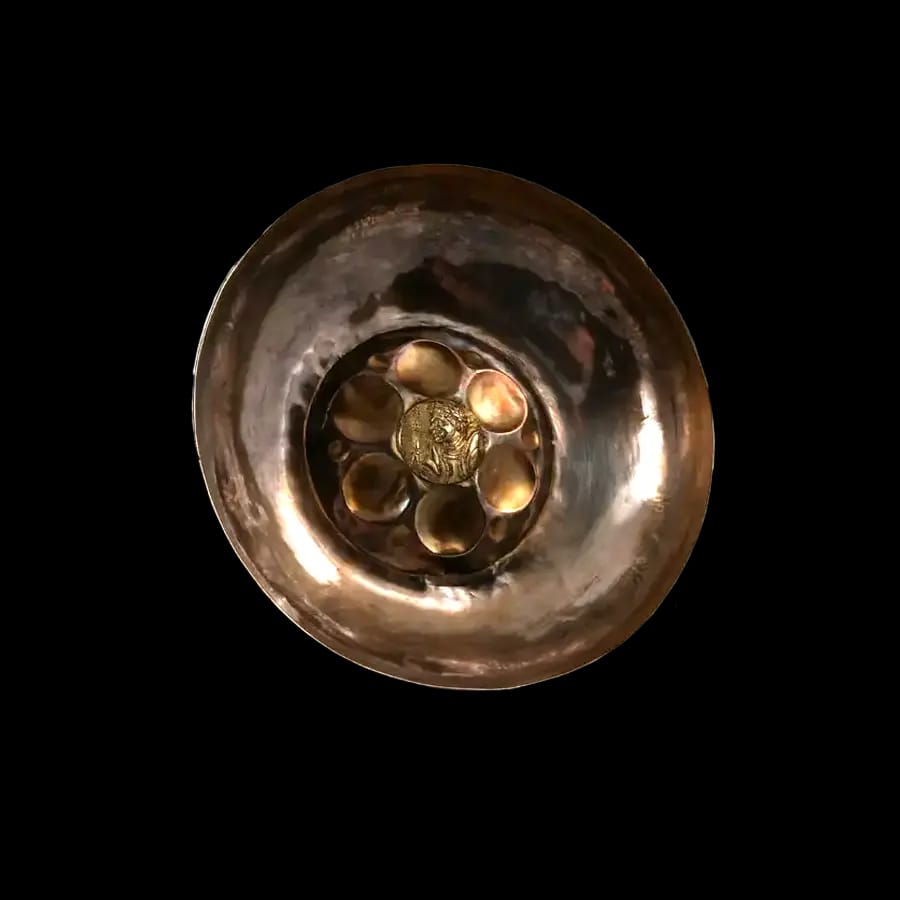
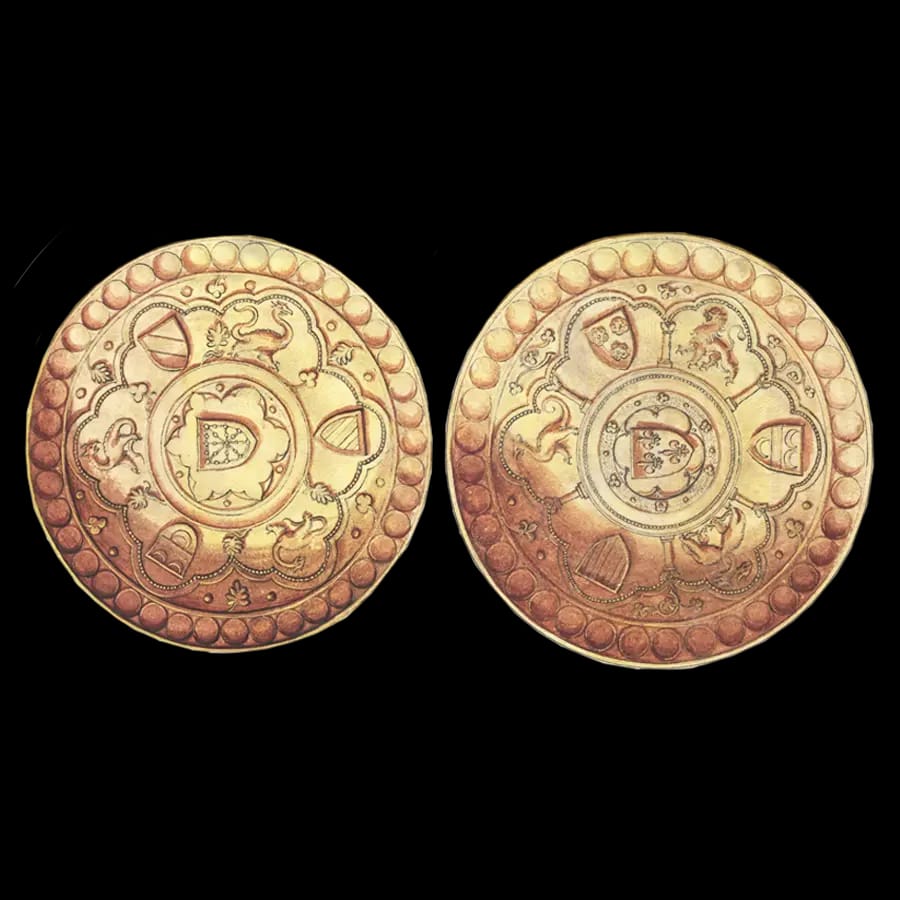
Sugared fruits, served in gleaming bowls, and large drinking vessels in the shape of ships impressed guests at the Burgundian court. The dukes (Herzöge) made their overwhelming magnificence evident through further, unused tableware, which they piled up on specially built pieces of furniture with many levels of shelves on which they could display their shining plates and goblets. The legendary wealth of the Burgundian court was famous even in the Confederate territories. After being captured, silver tableware came to stand for the splendor of the Burgundian Dukes’ table.
Looting silver
Plunder or pay?
The Confederates and their allies attempted to gather, list, and distribute the great mass of spoils in a controlled manner — with only moderate success.
“Carrying off spoils after a victory was common practice in the late Middle Ages. The capture of such large quantities of courtly luxury objects, however — such as the Burgundians’ silver and gold table plate — was nonetheless extraordinary. The Liestal Burgundian bowl was likely allocated to Heinrich Strübin from the spoils following the Battle of Nancy. At Grandson in particular, however, many soldiers evaded the control of the Confederate spoils-masters and secretly pocketed treasures for themselves.
Weighing and melting
Silver is a monetary asset. For this reason, Burgundian silver treasures were frequently melted down and sold.
In the booty registers (Beuterödeln) compiled after the battle that listed all of the objects seized, silver and gold objects were appraised according to their weight. The symbolic and artistic-craft value of the elaborately worked pieces from the Burgundian court was initially of little importance — partly because the duke owned so many similar vessels. The monetary value of the metals was what mattered most.
Many silver bowls from the Burgundian booty were sold and melted down. From the silver thus obtained, new works of art could be created, or coins minted. Individual trophies, however, became symbolically valuable as tellers of the story of victory, and thus escaped the metalsmith’s furnace.
Triumphant donations
Engraved in memory
Silver can be engraved well with a sharp steel burin. The Burgundian bowl tells its own story directly through its inscription.
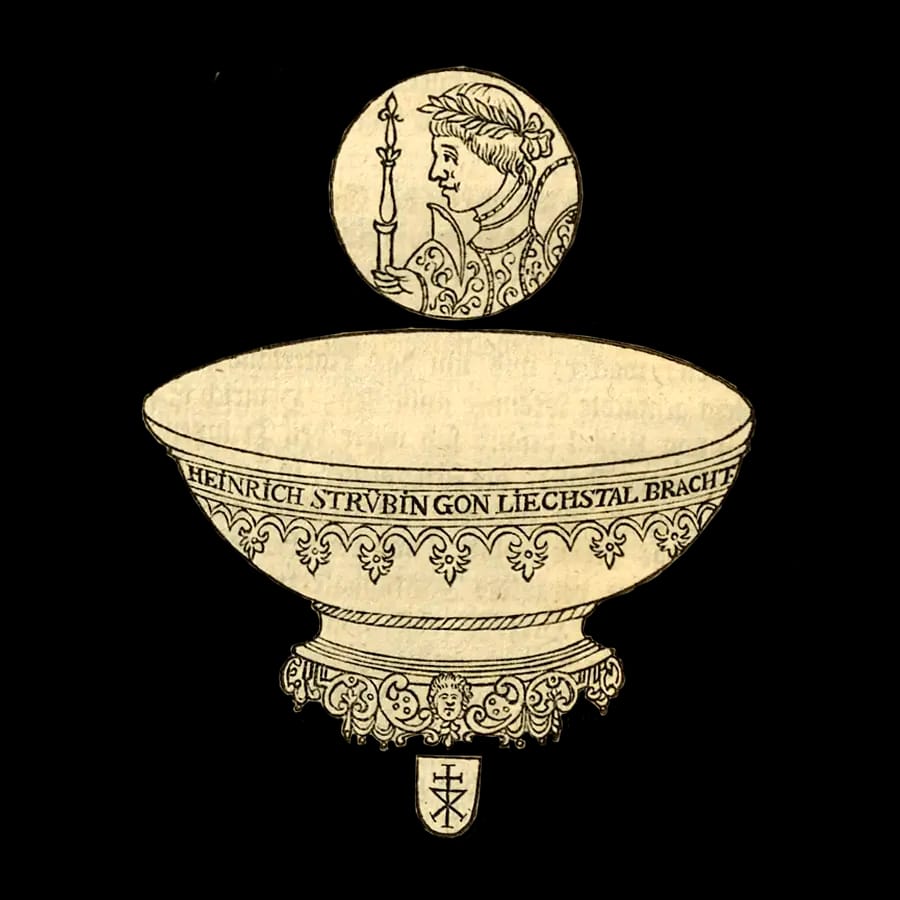
The bowl was not engraved, however, by its original conqueror, but only later, by Heinrich Strübin’s descendants. In this way, the victory was etched eternally into the metal of what had originally been a simple silver bowl — now transformed into a triumphant goblet. At the same time, the bowl was also outfitted with a splendid foot.
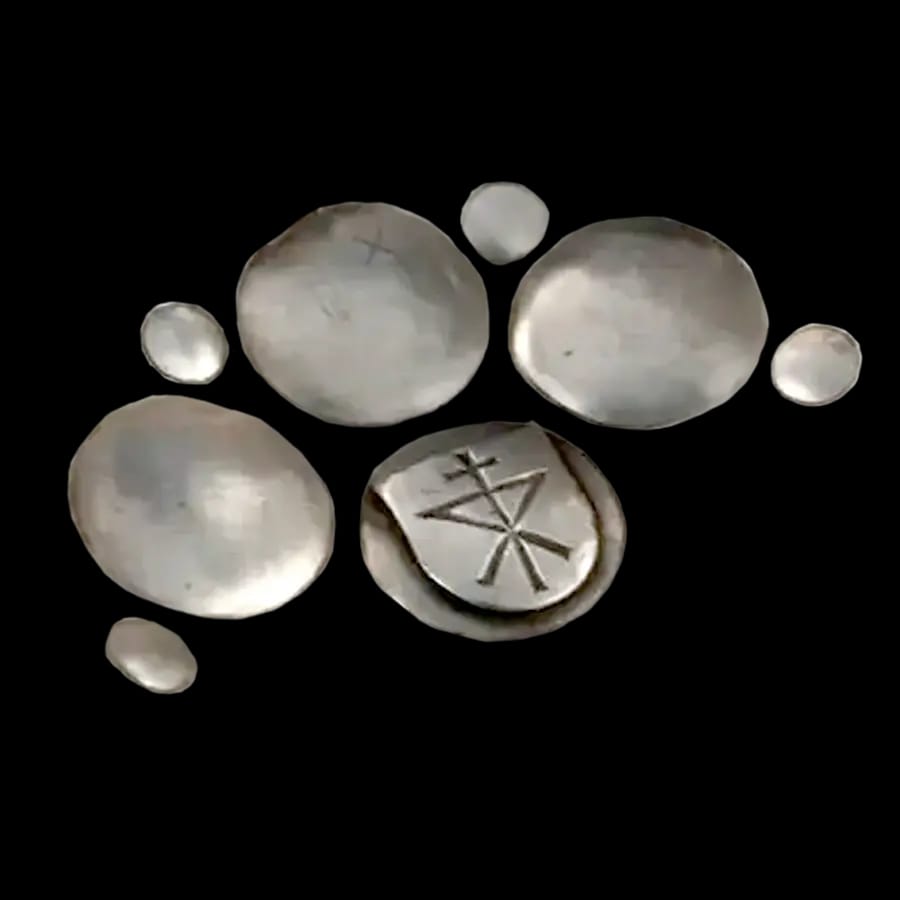
The confident patrician family from LIestal had their coat of arms cut into the bowl’s base, so as to bind themselves to their trophy forever. They modified the plain silver vessel so elaborately that it would better visually reflect its glorious history. What had been a simple silver bowl became a victory goblet, from which wine could be drunk together in communal rituals.
Booty as holy blessing
Sacred objects were also part the Burgundian spoils. These were sometimes were integrated as trophies into religious rites in the Confederates’ churches.
Silver chalices, and also relics, were initially part of the booty that was listed, distributed, and sold. Influential power players among the Confederates knew how to present themselves to advantage using ecclesiastical symbol-bearing objects. They often donated valuable silver chalices to local churches that the Burgundian duke had carried with him to the battlefield.
Donated objects like such chalices, which were newly consecrated and placed among church treasures, provided a means of enshrining and preserving the narrative of a glorious, victorious military history. They served simultaneously as trophies and as sacred vessels for the Mass. As with captured banners hung in Confederate churches, the victory over the Burgundians was framed through looted objects as a sacred event.
The chalice and the bowl both became victory trophies. As donations in different contexts, they preserved the memory of the victory stories of powerful families.
A tyrant’s bowl
The Duke’s bowl
The Burgundian bowl is outfitted with an unusual portrait — an image of the Burgundian duke?
Charles the Bold (Karl der Kühne) was also idealized as a historical figure. His legendary reputation as a magnificently wealthy duke outlived his death. One encounters him in collections of portraits of history’s great rulers. In the 17th century, the Burgundian bowl — already engraved and lavishly reworked by the Strübin family — was outfitted with an additional medallion derived from a frequently reproduced portrait of Charles the Bold that originated during his own reign. Before this, the plain bowl had no visible connection to Burgundy at all. The medallion transforms the bowl into a personal item of the duke. This raised its symbolic value when it later became a trophy goblet.
Subtle adaptations
Even though the bowl has no documented connection to Charles the Bold, the small portrait on its base points to a connection with the Burgundian court.
The original model for the portrait of Charles on the base of the bowl was a medallion presumably made by Giovanni Candida (ca. 1445–1504), who worked at the duke’s court.
Portraits on medals took antique imperial coins as their model and were meant to disseminate a recognizable image of the ruler. Such pieces later found their way into private collections. Basilius Amerbach’s famous coin collection in Basel (now in Basel’s historical museum) also included a ‘Charles by Candida.’
The Candida portrait originally showed Charles in the fashion of a Roman emperor, the ideal image of a powerful ruler. In the medallion of the looted silver bowl, this model was taken up but slightly adapted to emphasize the supposedly excessive claim to power and wealth of the defeated duke. In the portrait on the bowl, Charles has a scepter and armor. He now appears as a warrior. Does this make him seem more like a potentially bloodthirsty tyrant? Or, at any rate, an adversary that the Confederates could be proud of vanquishing?
Everything belongs to Charles
Various objects from the Burgundian booty were later linked directly to Duke Charles of Burgundy. Were these false attributions?
This fashionable fabric-covered armor does indeed date from the time of the Burgundian Wars, though a connection to the duke himself is not documented. According to older sources, the Basel troops did in fact capture a tabard bearing the Duke’s coat of arms — though it does not appear in subsequent inventories. Several cities laid claim to Charles’s armor for themselves: sources also report corresponding suits of armor in Bern and Zurich. No plausible surviving piece, however, has survived.
The portrait added at a later date has, in part, led even to this day to the mistaken assumption that this is ‘Charles’s bowl’ — a phenomenon that shared by numerous objects from the Burgundian booty - and even some that were not part of the spoils of Grandson, Murten, and Nancy. Objects were often claimed to have come directly from Charles’s own possession. In reality, however, the Liestal bowl was merely one of many plain silver bowls at the Burgundian court. Whether it belonged to Charles is unclear. Representative individual showpieces did exist as well, but none of these has survived from among the Burgundian spoils.
Between trophy and museum
Thirsty Swiss men
In the city of Liestal’s possession after 1800, the Burgundian bowl remained a ritual drinking vessel — only now in the spirit of the city as part of the young Swiss nation-state rather than an only individual family. The family had expanded into a national community
The annual communal toast and drink, established by an endowment from Crispianus Strübin, continues to this day. The memory of the Strübin patrician family’s heroic story remained relevant even after the founding of the nation-state in 1848, and contributed to the glorification and idealization of the state. As in many Swiss cities, old ruling families were able to preserve their power and influence. Drinking from the captured bowl — and, later, from a copy — now took on the symbolism of a national history in which the people of Liestal situated themselves as active agents.
A monument to the nation
In the young Swiss nation, the Burgundian bowl was no longer merely a symbol of the old elite, but transformed into a monument to the nascent national historical myth.
In 1795, the city of Liestal purchased the Burgundian bowl from the Strübin family. In the conflicted course of the founding of the nation, an image of national unity was promoted throughout Switzerland through objects like public monuments. In 1875, the woodcarver J. J. Brodbeck created a wooden pedastal and casings for the bowl adorned with national symbols and references to Antiquity. The bowl, together with its added wooden attributes thus thus was transformed into a historical monument of national history.
To drink or preserve?
Today, the Burgundian bowl is a museum object, but through its continued use as a ritual drinking vessel, it has also retained its social and symbolic significance.
As historical museums were founded in the 19th century, concerns over conservation and preservation arose in the new museum context. Today the Strübin bowl, purchased by Liestal in 1795, is also protected through conservation measures and a plexiglas box. Ritual drinking from the bowl, however, can still take place thanks to an almost identical copy. Interestingly, although the original was preserved in the city’s modern historical collection, it was still altered…Disparities between the drinking copy and the current state of the bowl reveal the complexities of historical bricolage.
This late intervention to a museum object is conceivable only because the Burgundian bowl remains, to this day, more than a historical object. The vessel is at once a living symbol of Liestal’s community and its heroic history — celebrated in the drinking ritual — and a (preserved) museum object.
In doing so, Spitzbarth attempted to reconstruct the form of the bowl immediately after its capture, at the moment when the victors engraved the rim and affixed their coat of arms to its base. In fact, however, these alterations were not made in the 15th century, but were later Baroque addendums too. Even in this supposedly more historically accurate copy we can see the complex ways in which historical layering interweave.