Bodies of steel
Brand-name armor
The suit of armor in Bern was once a prestigious steel garment, presumably for a wealthy nobleman.
The many symbols on the Bern armor testify that it was made in Milan. In the 15th century, entrepreneurial families from northern Italy were leaders in armor production. Money alone could not secure a custom-made armour. Buyers also needed political connections to the duchy of Milan.
Through the “brand” markings, the wearer of this expensive, made-to-measure piece put his wealth and prestige clearly on display. He showed how he could afford the best armor money (and status) could acquire.
Sculpting the noble body
Slender legs, a narrow waist, powerful shoulders — the elegant yet powerful ideal body of the 15th century.
Armor, remarkably flexible thanks to its structure of interlocking plates was not only functional in its form, but also aimed to outfit the wearer with an attractively idealized silhouette.
In a painting by the Italian painter Andrea Mantegna (1431–1506), a very similar suit of armor is depicted in its complete form. The painting highlights the figure’s elegant, elongated form with broad shoulders.
Faded designs
The violence of battle and plundering ripped the suit armor from its courtly context and brought it to Bern. This violent loss remains evident in traces left on the armor itself.
Looted objects often lose their original meaning as they are transferred from one context to another. On the Bern suit of armor, this becomes visible through traces on the object’s surface. Fine dotted lines once decorated the bluish steel with vines and blossoms, of the kind also found at court on precious fabrics. In the Bern arsenal, however, this courtly elegance was no longer of central importance. Like all suits of armor, this one, too, was regularly polished to maintain its shine and prevent rust. In the process, the delicate ornamentation — and, in part, even the maker’s marks — were increasingly worn away.

Heroes of steel
Retrofitting history
In the Bern arsenal, the suit of armor was presented as the steel garment of the city’s mythical founder.
The Bern armory was not merely a storehouse for military supplies, but also a testament to the power of the city, and a site where Bern’s glorious history was staged. Captured trophies and other objects — together with painted wooden mannequins, flags, and paintings — told stories of the emergence of what was, for a time, a very powerful city-state. Berchtold V., the legendary founder of Bern, played an important role in this history.
In the arsenal, the patrician leaders of Bern installed a painted wooden figure of Berchtold and dressed it in the Milanese armor. Such wooden figures stood at various points throughout the arsenal, functioning as small waystations of sorts, where important episodes of the glorious founding narrative were staged with martial pathos.
Bearish Berners
According to legend, Berchtold V. von Zähringen was closely associated with the bear as a symbolic animal— a fitting match for the armor in the armory?
According to the mythical history of the city’s founding, Duke Berchtold V of the Zähringer dynasty organized a hunt. The bear that was killed gave the city its name: Bern, like bear (Bär, in German). In the numerous depictions of this legend in chronicles, songs, and paintings, the lords of Bern recounted their mythical history, particularly in the 16th century. In many of these depictions, the bear and Berchtold appear together, or they refer to one another.
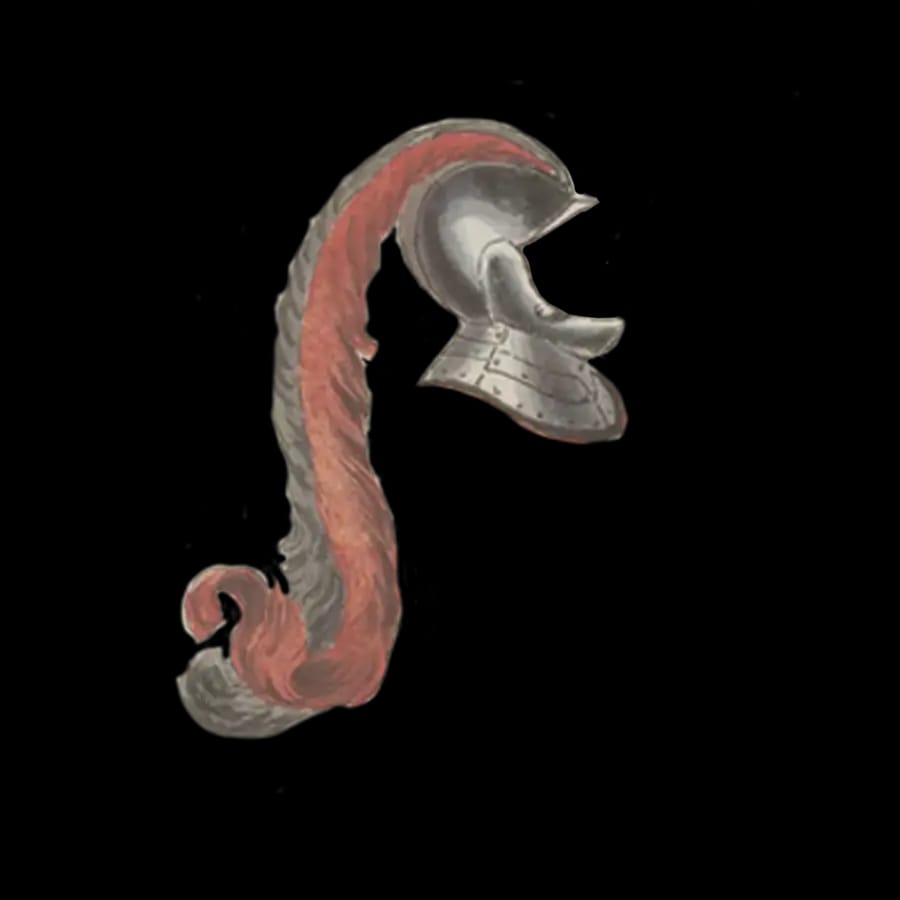
The grand bascinet—the large helmet that is part of the “Berchtold” armor—looks a bit bearish. The connection between the man, the animal, and the armor is perhaps not entirely random.
The snout-like form of the helmet was a particular design choice. It was also not especially common, which is perhaps why this particular MIssaglia suit was connected to the urban legend of Berchtold and the bear.
Trophies for bearded Swiss men?
In the Bern Armory, mannequins clad in ancient armor symbolized the structure of power and notions of virility.
The old Confederates, victorious in battles such as those of the Burgundian Wars, are still regarded by some today as the epitome of the God-fearing, modest, duty-bound Swiss man. Accordingly, the armored mannequins in armory displays like the one in Bern, have always served as visual representations of “righteous,” warlike men. This is evident in the design of their faces. The wooden and clay masks of the warrior figures evolved in line with changing visual ideals of masculinity—from the elegant mustache of the 18th century to the rugged beard of the 19th century.
The warrior figures in the armories must have struck visitors as entertainingly grotesque, yet also somewhat frightening. Visitors described their menacing appearance in the dimly lit halls.
The Armory Master led visitors through the rooms and may have embellished the displays with stories.
Recycling booty
A piece of armor captured in the 15th century was long said to have belonged to Berchtold V? Today, this seems questionable…
Dem erbeuteten Harnisch eine völlig neue Geschichte anzuhängen, war für die Berner im 16. Jahrhundert eine sinnvolle Verwertung einer alten Rüstung. Militärisch konnte man sie nicht mehr verwenden. Einst ein luxuriöser Harnisch eines wahrscheinlich burgundischen oder savoyischen Adeligen, war sie unter den Trophäen und eigenen Rüstungen und Waffen im Zeughaus ein seltenes Stück, aber eines ohne Geschichte. Damit bot er sich an für die Ausstattung der Berchtold-Figurine. Diese historische Überschreibung gehört also zur Geschichte des Harnisches und ist mehr als nur eine “falsche” Zuschreibung.
Triumphant together
History made from the old and the new
In Bern, history was repeatedly reenacted in street parades. The costumes consisted of actual trophies and all sorts of replicas.
One well-documented example of such parades is the celebration of the city’s founding planned in 1791. Bern’s history was to be presented in four scenes. Berchtold V, as the city’s founder, led the first procession. The Burgundian Wars, featuring a variety of genuine and less-than-genuine spoils of war, served as the final act. Records show that the armory was supposed to supplied armor and other items for the performers’ historical costumes.
Just how politically charged such parades could be is evident from the fact that the 1791 celebration was ultimately canceled due to revolutionary tensions. At that time, the old war heroes could be seen not only as a conservative argument in favor of the old regimes of the Swiss cantons, but also as a call for reform. It is unclear whether the Missaglia armor was going to be used as Berchtold’s armor in 1791. However, marks on the steel suggest that it was certainly used at various moments.
Lost origins
Without a name
Many objects that were claimed to be part of the Burgundian booty in fact have obscure origins.
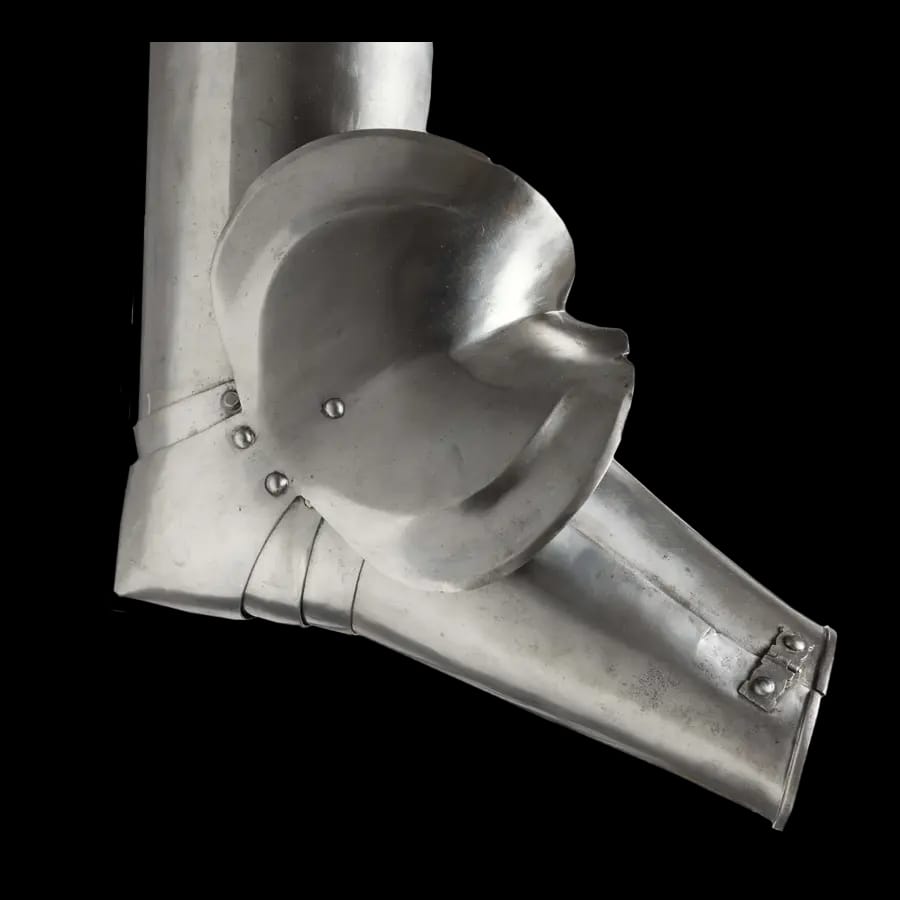
The suit of armor in Bern was long dubbed the ‘Berchtold armor,’ named for the city’s founding father Berchtold von Zähringen. In reality, however, it most likely came to Bern as booty from the Burgundian Wars. Its original context has been erased down to only a few traces. Alongside the Milanese maker’s marks and its form, typical for armor around 1450, only a fragmentary inscription — hidden on the lip of an arm opening — still reveals who its once wealthy and style-conscious owner may have been.
Made in Milan around 1450, identifiable by its maker’s marks and characteristic form, this type of armor was especially popular among Savoyard nobles — allies of Burgundy in the fight against the people of Bern and their fellow combatants in the Burgundian Wars. For this reason, from today’s perspective, the suit may have belonged to a wealthy Burgundian or Savoyard.
Traces of violence
These traces of combat serve as a reminder that armor remains bound up with violence, even though for most of its history, the Bernese suit of armor glistened far removed from any battlefield.
In the 15th century, the Bern armor was likely still in active use, as the notches on the suit indicate. In the city arsenal, the armor was transformed into a historical object, an heirloom. It lost its protective function and instead became a material symbol of historical legend, taking its place alongside other war trophies (as well as weapons that were, indeed, used in contemporary combats). For centuries, the armor in the arsenal embodied a history of Bern founded on violent expansion — one that justified later wars and the political ambitions of the city elites. Though no longer functional in a military sense, the suit of armor remained bound up with the city of Bern’s self-presentation as a military power and could be mobilized to justify a variety of claims.
A myth destroyed
History is continually re-evaluated and rewritten. Ultimately, even the ‘Berchtold armor’ was separated from its myth.
When specialized museums were founded in Bern during the 19th century, the old weapons from the Bern arsenal were brought together into a unified “historical” collection. The first director of the Historisches Museum in Bern devoted himself to this collection. His catalogue debunked the old myth that attributed the suit of armor to Berchtold von Zähringen.
Through comparison and close examination, the armor was identified as a work of the Milanese armorers Missaglia, made around 1450, and thereby divested of its mythical connection to the city’s legendary founder, Berchtold V. Its long-standing attribution as the ‘Berchtold armor’ was thus disproved, as part of a precedent for more scholarly research into the ‘true origins’ of objects in the recently founded historical museum’s collections.
Burnishing history
In the postwar period, and in light of more accurate historical research, a large part of the old war trophies were banished to museum storage. Not, however, the Missaglia armor. A select few pieces of armor that were made with exceptionally skill continued to find a place in museum displays, only now under different auspices.
By the mid-twentieth century, there was no longer a place for the silent army of steel heroes that once peopled armory and historical museum displays. The martial past of museum collections which had previously been emphasized as part of a heroic Swiss past thus receded into the background. The Old Arsenal in the city of Solothurn forms an exception: to this day, the Altes Zeughaus still presents its historical armor and weapons collection in full abundance, recalling the former significance of such objects in the formation of Swiss cultural heritage.