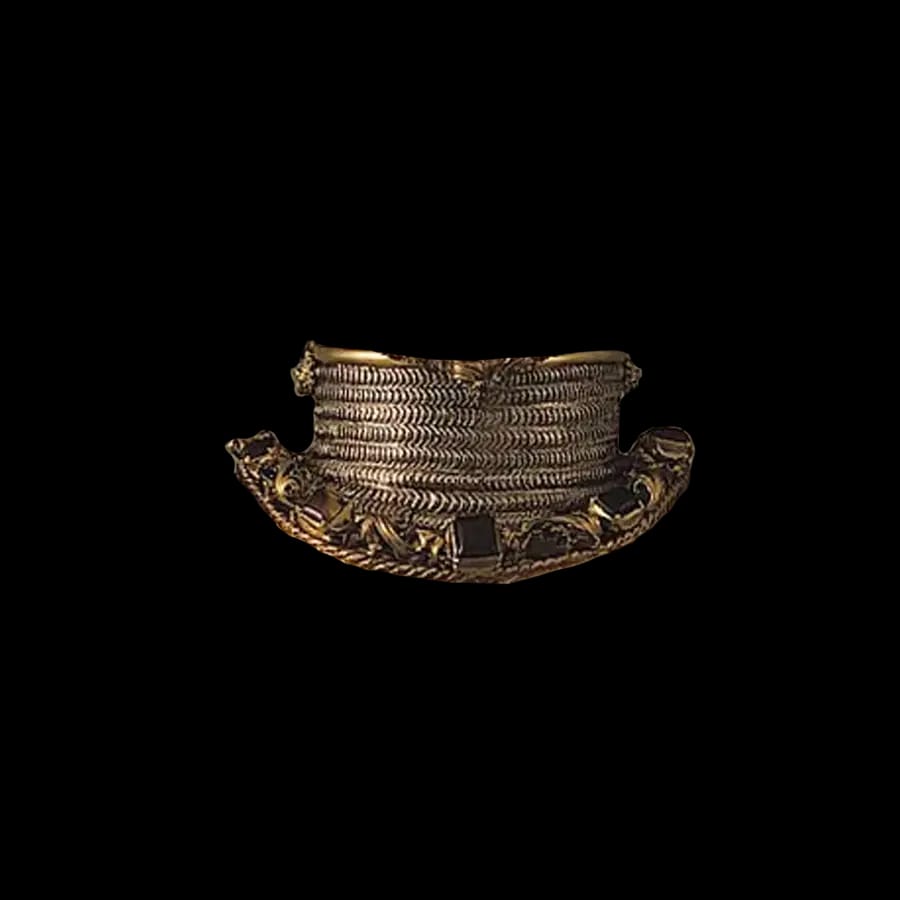
A chain for St. Ursus?
Loot or pious gift?
The bust of St. Ursus in Solothurn Cathedral already wore several valuable pieces of jewelry in the 17th century, donated by wealthy citizens.
To secure salvation, to make one’s standing visible, and to be remembered, votive offerings such as the many “chains” on the St. Ursus reliquary were ideal. The silver bust held remains from the grave of St. Ursus, a holy relic. In 1519, during the rebuilding of the church in Solothurn, remains were found in the old altar with a reference to the legionary Ursus. According to legend, he died a martyr’s death in Solothurn because he and his legion refused to take part in pagan rituals.
Church treasury inventories recorded relics, their precious vessels, and other treasures with their weights and notes on who had donated them. This was the case for St. Urs’ bust and the many chains around its neck, including the Marian girdle.
Mysterious donors
Research in archival documents resolves some questions while simultaneously raising new ones. The origin of the Marian girdle remains shrouded in mystery.
While the girdle appears in and inventory of 1648 as a velvet belt with gilded roses, a later inventory describes it as a ‘velvet girdle with gilded roses, crowns, and letters.’
Inventories are often very difficult to connect to specific objects, since the entries are usually brief. In this case, however, the connection to the Marian girdle is fairly clear, and it reveals something astonishing. As late as the 18th century, the chain was still backed with red velvet. The inventories, however, do not mention who may have donated this piece to the church.
An object of study and inspiration
“Rediscovering” a masterpiece
In the 19th century, the Marian belt, which had long been understood as a votive gift to St. Ursus, was reclassified as an example of masterful Burgundian metalwork and part of the fabled Burgundy booty.
In the 19th century, many historical objects were subjected to fresh interest and renewed study. Under the scrutiny of specialists such as the Lucerne antiques dealer and silversmith Johann Karl Bossard, the mysterious chain around the neck of St. Ursus was newly identified as Burgundian metalwork — and thus as war spoils from the battles against the Burgundians.
As a Burgundian masterpiece, the chains was later brought to the city arsenal, where it is still exhibited today alongsie other pieces of Solothurn’s share of the Burgundian spoils. The discovery came at a very convenient moment, since many pieces of the spoils had been lost.
Royal quality or cheap imitation?
The legend of the ‘Burgundian chain’ rests on a shaky foundation. If we examine the physical links in the object closely, and doubts — and new questions — emerge.
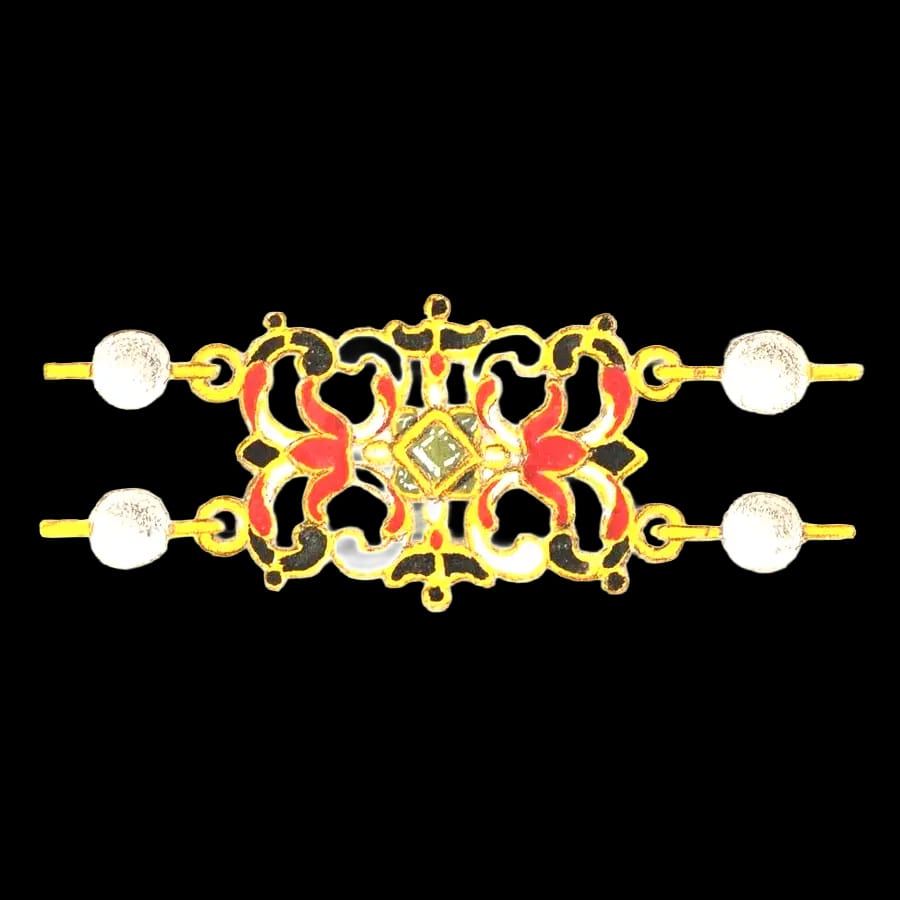
When people claimed the chain was a part of the Burgundian booty, it was connected to Charles’s only daughter, Mary of Burgundy. The ‘M’ links in the chain were said to refer to the Burgundian princess. Chains and jewelry were indeed popular at the Burgundian court. Goldsmiths such as Gérard Loyet produced several magnificent works in solid gold and precious stones. The Marian girdle, however, is not made of especially precious materials. It is only gilded silver, with its ‘pearls’ made of inexpensive enamel.
Mending holes in history
In the 19th century, copies of military trophie were frequently made to fill in the gaps of the medieval record: missing objects, missing pieces of objects, and ambiguous provenances could be obscured by simply making new objects that were deployed to support grand Swiss historical narratives.
Copies, such as those by the famous goldsmith Johann Karl Bossard appeared just like originals. A ‘Burgundian goblet,’ for example, allegedly excavated near Murten around 1840 is actually full of holes. But Bossard “restored” it by making a copy without holes while the original was in his family’s possession.
Based on the heavily damaged ‘original,’ Bossard manufactured a seemingly perfect facsimile — without holes. This copy appeared as if it had been taken directly from Charles the Bold’s own table- a notion spelled out on the cup’s bottom.
The inscription on the goblet’s underside fills the holes in the archaeological find. Although admitting that it is a facsimile, it declares that the original belonged to Charles the Bold himself. Bossard dedicated his gleaming facsimile to the Zurich Guild “zu Kämbel,” and thus to the city’s urban elite who had long staged themselves, through objects such as Burgundian bootys, as direct heirs and descendants of the victorious Confederates. Bossard had a very similar interest in the Marian girdle as in the Burgundian goblet… through the new attribution, the former votive offering from Solothurn’s cathedral treasury was transformed through Bossard’ expert authentification into a trophy from Burgundy.
The Middle Ages as inspiration
During industrialization, the Middle Ages appeared as a source of social and aesthetic renewal. Trophies of war, too, were turned into art.
Like many of his contemporaries, the Lucerne goldsmith Johann Karl Bossard drew inspiration for his own work from historical medieval and Renaissance styles. His sketches and copies show how carefully he studied medieval objects, striving to match medieval originals in style and craftsmanship. But he also filled his work with inventions and expanded upon his original sources.
From his very hands-on and assiduous study of historical objects„ new creations emerged — ‘strictly in the style of a particular period,’ as Bossard himself emphasized.
Real or fake?
Where does the fine line lie between reconstruction, copy, and historical original?
Bossard worked with such precision that the boundary between historical original and 19th-century imitation remains, in part, blurred to this day. Individual links of the Marian girdle have survived in the silversmith’s estate.
Bossard’s restoration work on the object is not precisely documented. In the process, however, he did not fill in all the gaps. To this day, the ‘chain’ still ends at one point without a clasp. This is an indication that, before it was hung around the neck of the St. Ursus bust, it was perhaps indeed made as a girdle.
Gebastelte Geschichte## in Englisch?##
Das fantastische Zelt des Herzogs
Im 19. Jahrhundert wurden an vielen Orten der Schweiz Museen gegründet. Die Burgunderbeute wurde dort auf pompöse Weise neu inszeniert und dazu neu genäht.
Das Zeughaus von Solothurn, das später selbst zum historischen Museum wurde, vereinte sowohl historische Objekte als auch Reproduktionen und sogar Fälschungen. Ein imposantes “Zelt aus dem Lager des burgundischen Herzogs” beherbergte solche zweifelhaften Exponate. Das Nachbauen des Zeltes war eine Weise, Geschichte ins Leben zu rufen und durch Prozesse der Reproduktion erfahrbar zu machen.
Die verschiedenen Objekte in der Fotografie des “Beutezeltes” sollten ein möglichst lückenloses und prächtiges Bild der Geschichte “Burgunderbeute” vermitteln.
Ob auch der Mariengürtel als vermeintlich burgundisches Beutestück Teil der Installation im Solothurner Zeughaus war, ist unklar. Bei der Landesausstellung in Genf wurden allerdings sowohl das Zelt mit seinen Begleitobjekten als auch die “Kette” als erbeuteter Schmuck der burgundischen Prinzessin Maria ausgestellt.
Ein Trophäenzelt für die Schweiz
Eigens für die Landesausstellung des jungen Nationalstaates Schweiz von 1896 in Genf wurde ein burgundisches Zelt angefertigt.
Vor dem “Burgunderzelt” in der Genfer Ausstellung ruhte das schwere Geschützrohr aus der Burgunderbeute, das als einzig übrig gebliebener, grosser Bronzeguss des burgundischen Geschützmeisters Jean de Malines extra aus Basel durch die ganze Schweiz transportiert wurde.
Die Ausstellung rund um das Burgunderzelt verdeutlicht die fantastische Erzählung über die Burgunderbeute und den ruhmreichen Sieg der eigenen Vorfahren – eine Erzählung, die an der Landesausstellung neben anderen symbolischen Bereichen präsentiert wurde.
Nahe am Ausstellungsbereich “Antike Künste” befanden sich auch ein “Afrikanisches Dorf” und ein “Schweizer Dorf”. Zeitgleich wurden neue technische Errungenschaften der Schweiz präsentiert. Damit fügte sich die Geschichte über die Burgunderbeute in das Selbstverständnis der Schweiz zwischen ruhmreicher Vergangenheit und fortschrittlicher Zukunft, zwischen dem Eigenen und dem Fremden, ein.