Masterful new weapons
Top guns
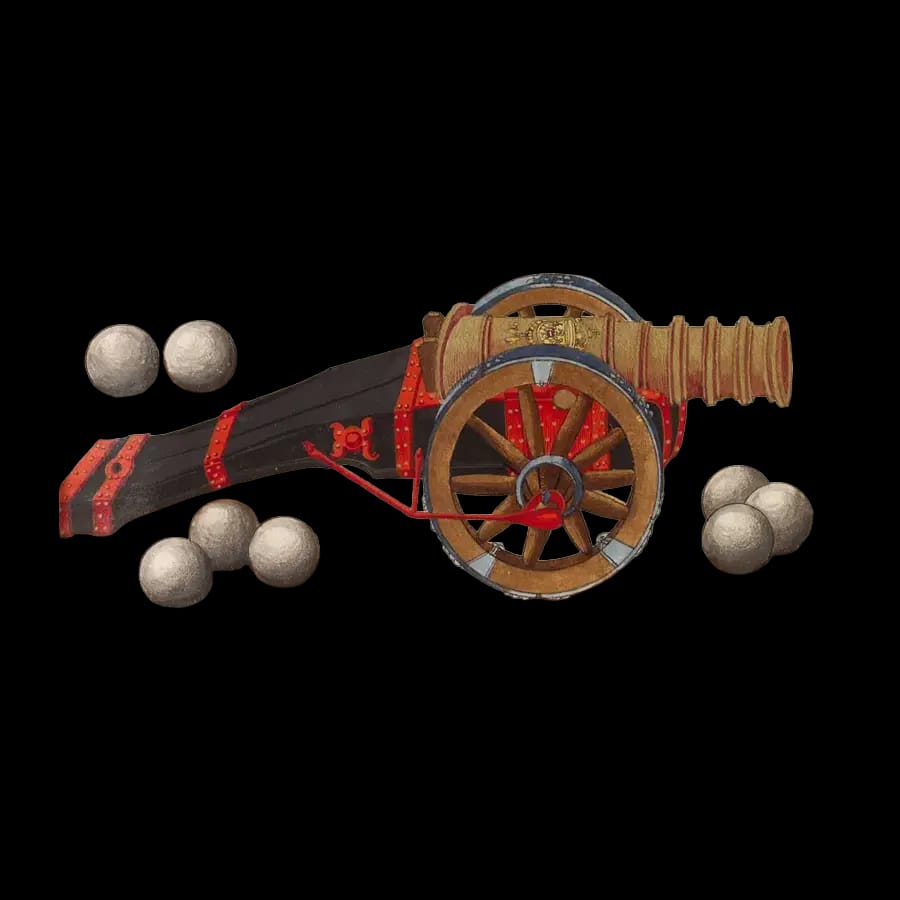
In 1474, the gun founder Jean de Malines from Mechelen was commissioned by Charles the Bold to produce five novel cannons based on the model known as a Courtault.
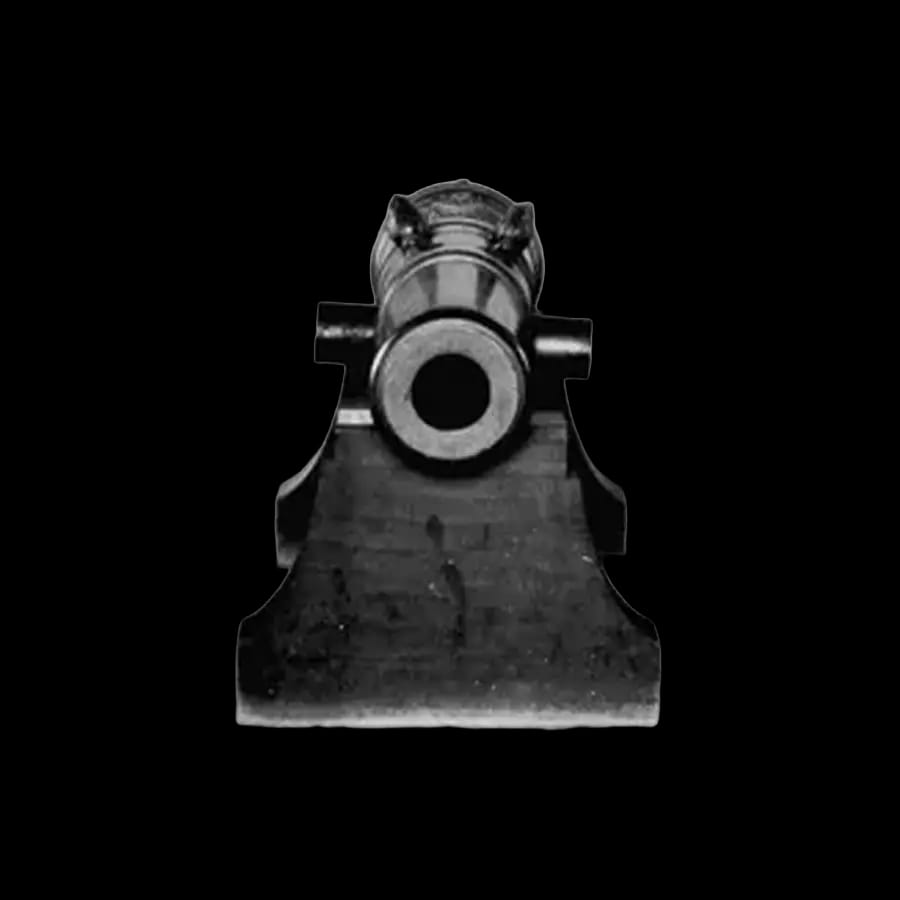
The cannon preserved in Basel is presumably one of the oldest featuring a trunnion. Trunnions are cylindrical protrusions on the side of the shaft that made it easier to swivel and align the barrel, thereby increasing the accuracy of the shots. These novel cannons fired stone balls. They came to replace older types of artillery.
Earlier types of artillery such as so-called serpentines or “Schlangen” (serpents) fired far with high precision thanks to their long barrels. Their balls weighed roughly 5–15 pounds and were generally made of bronze, or, less frequently, of iron.
The short courtault filled a tactical gap between the precise but unwieldy “Schlange” (serpent) and the lighter field guns. It had less range than the “Schlange,” but was more mobile and well suited for use at medium distance or in sieges. Contemporary witnesses paint a vivid picture of the destructive power of these new cannons.
Armed with armorials
The cannon speaks for itself through an inscription on the metal.
The cannon declares through an inscription that it was created in 1474 by the Flemish gunsmith Jean de Malines of Mechelen. Further details also clearly explain that it was cast explicitly for Charles the Bold.
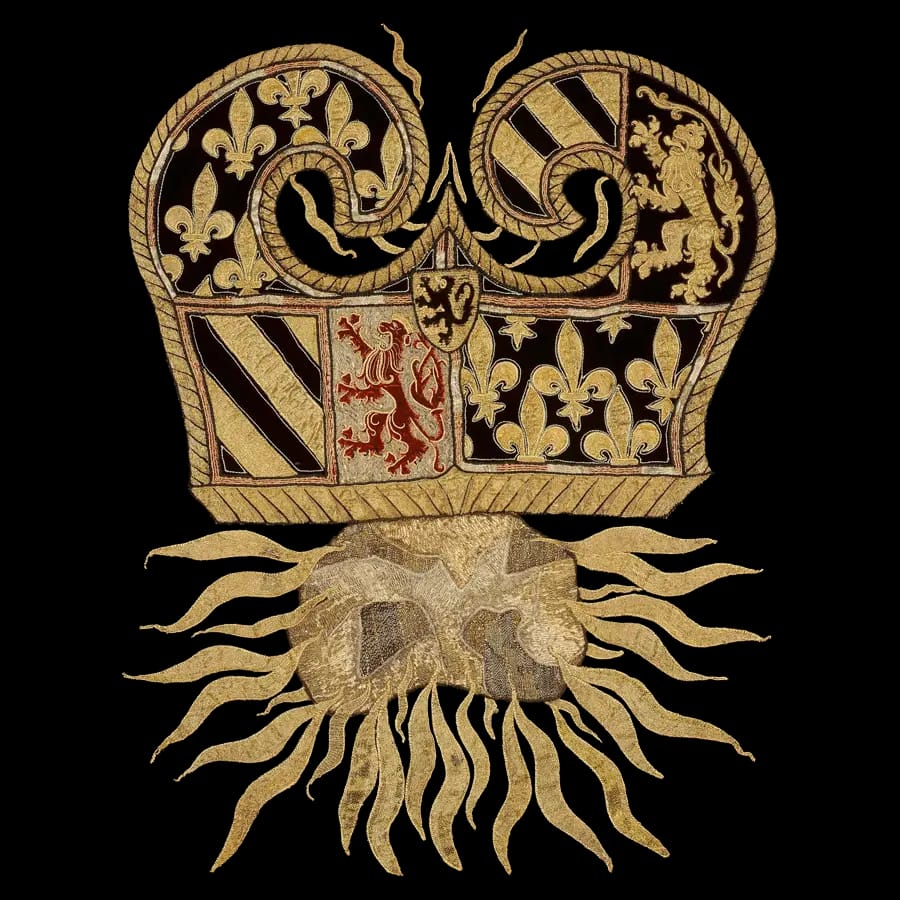
The second segment of the gun barrel is adorned with the coat of arms of the Burgundian duke, which appears alternating with elements of his personal emblem (Bilddevise).
Highly coveted spoils
Booty bearing the coat of arms of Charles the Bold were especially coveted spoils of war. In the hands of the Confederate victors, the duke’s symbols of power became emblems of their triumph.
The Basel chaplain Johannes Knebel described in his chronicle that the people of Basel returned from the war with Charles the Bold on Wednesday, 14 March 1476. From the battlefield they brought back two large bombards — as Knebel calls the gun barrels — bearing the Burgundian coat of arms to Basel.
One of the great Confederate historical myths is that the booty was divided up fairly. In fact, however, the division processes was highly contested. In his Bern Chronicle, Diebold Schilling the Elder did not hold back his criticism of the plundering after Grandson. He describes the chaos after Murten as well: some of the assembled spoils were even stolen directly from the depot. The supposedly orderly and equal distribution of booty was more of a wishful dream than a reality.
Broken bodies
Painted slaughter
New military technology led to a new kind of warfare. This becomes evident in new representations of war and violence made during the time of the Burgundian Wars and the decades that followed.
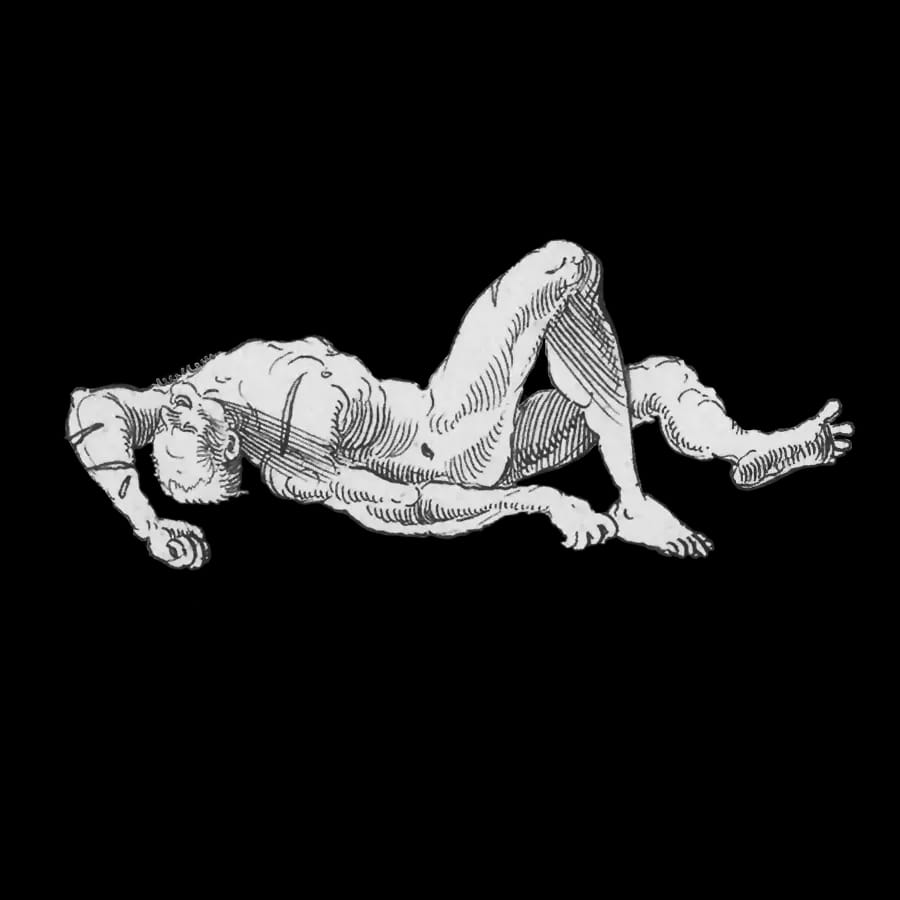
The development of new weapons like Charles the Bold’s bronze gun barrels led to different strategies on the battlefield, but also to different forms of injury. In a drawing by the mercenary Urs Graf of the a battle from the Italian wars (perhaps Marignano) in 1515, vividly presents the destructive force of these gun barrels’ explosive power, even though the cannons themselves are removed into the background.
At Marignano, around 20,000 Confederate mercenaries in the service of the Duke of Milan lost their lives. In Graf’s depiction, while the cannons appear, the marks of violence on the bodies of the fallen in the foreground were caused by cutting and stabbing.
The effects of new artillery and weapons like the duke’s cannons appear ambivalently in the illustrations of the Schilling Chronicles. Cannons are visualized as versatile weapons in sieges and in the field, but not as a decisive factor in battle. Regarding the fighting at the final battle of Nancy, the chronicler Schilling reported that the Confederates were able to circumvent the duke’s powerful cannons. The culverins could not be realigned quickly enough and therefore had little impact.
The depiction of the Battle of Murten in the Lucerne Schilling is presumably based on a large painting of 1480 in the Freiburg town hall. The 17th-century print by Martin Martini was likely also based on the same painting, which is now lost. In these images, artillery is not the primary cause of violence and destruction. Nor is it shown as having a decisive military effect. On the contrary, the Swiss are victorious in spite of their lesser firepower.
Battle depictions in general, including in the chronicles, did not primarily serve a documentary function. The actual death toll from artillery in the Burgundian Wars remains unclear. Yet pictures testify to the influence that cannons and artillery had in the cultural imagination, if not necessarily in direct experience of warfare. In Urs Graf’s image with the Roman war gods Mars and Bellona, for example, the artist foregrounds the force of cannons: riding a smoking cannonball, the bringers of doom fly over the war-ravaged land
Suffering in the countryside
In the Burgundian Wars, both warring parties plundered the countryside, inflicting serious violence, pain, and displacement on the inhabitants. The veneration of spectacular war trophies like the Burgundian cannon conceal this wartime violence, while simultaneously glorifying the military might of war technology.
For his Bernese patrons, Schilling emphasized the cruelty of the Burgundians toward the civilian population and their desecration of church property. During the conquest of Vaud and the plundering in Alsace in 1475, however, the Confederates rampaged in exactly the same way.
Women, too, were affected by wartime violence. The corresponding depictions in Schilling’s work are likely also connected to an ideological interest in the sexualized portrayal of the Burgundians and Charles the Bold.
Violence took many forms. The technologically sophisticated cannons of Charles the Bold were only one manifestation of lethal force, and their effectiveness as instruments of war in the battles against the Confederates remains an open question.
In search of the duke’s lost cannons
Cannons conversing in the Basel arsenal
In the late medieval arsenal of Basel, the cannons themselves seem to speak of their own destructive power.
The people of Basel brought two large bombards bearing the Burgundian coat of arms straight from the battlefield home to Basel. They were kept in the arsenal on Petersplatz. The armory had been built in 1438 as a grain store and served, until the 18th century, for the storage of both weapons and grain. Almost nothing remains of the arsenal building today
Some fragments of the late medieval wall paintings from the Basel arsenal have survived. They reveal the old arrangement of the cannons displayed there around 1474, before the Burgundian spoils were added. To the right of the ‘Widder’ (‘Ram’) and the ‘Rennerin’ (‘the Runner’), one named ‘Burgunderin’ was later installed — the cannon still kept today in the Historisches Museum Basel.
Rhymed verses were painted on the walls above each cannon. The texts that extolled the merits of each weapon, formulated in the first person, as if the cannons were speaking themselves. Accompanying the texts were emblematic images. The so-called Rennerin (‘the Runner’), for instance, is shown as a horse rider at full gallop, whip raised, chasing after her own banner scroll. After the Burgundian Wars, a new rhyme was added to the wall: ‘Burgund bin ich genandt – brich Maur und Want’ (‘Burgundy I am called – I break wall and partition’). The “Burgunderrin” (Burgundian woman) was just one of several trophies included in the Basel armory display. There was also the ‘Strauss’ (‘Ostrich’) from Grandson and the ‘Rauch’ (‘Smoke’) from Murten.
The ‘Burgunderin’ by Jean de Malines left the arsenal in 1874 and was included in the city’s medieval collection. This collection formed the core holdings of the Historical Museum when it was founded in 1894.
The Burgunderin’s lost sisters
Traces of the four lost gun barrels from the same series as the ‘Burgunderin’ in Basel turn up in various places. Yet their fates remain mysterious.
The Basel arsenal inventory listed two Burgundian cannons of the same caliber up until the 1790s. In 1874, however, only one of them was transferred to the newly founded Historisches Museum and remains known todaay.
Indeed, beginning with the inventory of 1837 onward, only one cannon appears in the records. Was it melted down? A list of cannons that were melted down during the during the Helvetic period (Helvetik) does not reveal a cannon with a weight comparable to the one by Jean de Malines preserved in the Historisches Museum. The destiny of the second bombard (Bombarde) that the Basel chronicler Knebel claimed came to Basel from the Burgundian Wars in 1476 thus remains a mystery.
If the four other cannons from the set that Jean de Malines cast for Charles in 1474 were melted down, where did this happen and when?
An archival entry from Fribourg dated 1503 clearly mentions a Burgundian cannon with a dragon head, which in size, shape, and length could correspond to the cannon preserved in Basel. Freely translated, the entry reads: ‘[…] a large Burgundian cannon, with a dragon’s head at the end, bearing a ring in the middle and turned/bored out at the front, standing on a two-wheeled cart (reding).’
This cannon, which had been kept in the town hall in Fribourg before the arsenal was rebuilt, has also not survived.
The Bern arsenal inventory of 1719 records two Burgundian cannons of similar size and caliber to the specimen preserved in Basel. The Bern cannons likewise no longer exist. Were they perhaps taken away in 1798, along with other spoils from the Bern arsenal and town hall, by French troops?
These cannons - once prized war trophies - have disappeared: one from Basel, perhaps one from Fribourg, and possibly two from Bern. How did once so mighty (and heavy) objects leave such faint traces in the historical record?
Yet another Burgunderin?
A gun barrel in the armory book of Emperor Maximilian is strikingly similar to the Burgundian gun barrel in Basel — almost indistinguishable. But is it one of Jean de Malines’ original five?
The accuracy of the drawing of the ‘Burgunderin’ in Maximilian’s armory book is unclear. A clue, however, hints that it is not the same cannon as the Burgunderin in Basel.
The ‘Burgunderin’ in Maximilian’s armory book, used at the 1504 siege, likely originally belonged to Charles the Bold and came into the hands of imperial troops as booty during the conflict between the Burgundians and the Habsburgs in 1474/75, later passing into the possession of Emperor Maximilian I. This ‘Burgunderin’ was thus also Burgundian war booty — but it did not come from the Confederate cache of booty taken in the Burgundian Wars. The splendid armory book also vividly shows how such weapons were produced. On another page of the same manuscript, various types of metal are depicted. Particularly striking is the copper ingot at the left edge of the image.
The aim of this representative manuscript was to document innovations in the field of artillery and to demonstrate Maximilian’s power. Old and novel cannons were described and illustrated in it.
Women at the margins of history
Women — vanished without a trace
Jean de Malines’ cannon in the Basel Historical Museum still known today as being part of the fabled Burgundian spoils, but other types of war booty have fallen into oblivion.
Among them, presumably, were also some 3,000 women. The cannon was known by the female name ‘Burgunderin,’ yet the camp women who appear frequently in the Bern Chronicle by Diebold Schilling remain almost entirely anonymous. Their lived reality remains a gap in the historical narrative.
In this inventory of booty (Beuterödel) from Lucerne, a paucity of entries nonetheless make clear that women were involved in the trade of war booty. They appear as agents in the attempt to improve their circumstances and share in the profits of plunder. The source also points to their role as sex workers.
The focus on women’s sexual services is particularly evident in Schilling’s illustrations, even though he distinguishes between three groups of women: the 3,000 women of the Burgundians, the standard-bearers or women paid by the cities who accompanied the marching army, and the accredited prostitutes in the Burgundian army. These three groups should not be equated with one another.
“In his military ordinances, Charles the Bold had limited the number of women per company of 900 men to 30. These women were placed under the authority of an officer (in the German armies of the Thirty Years’ War, this officer was called a ‘Hurenwirt’ [lit. ‘whore-master/keeper’]). These women were accredited — that is, they had to pay a fee and were then incorporated into the army’s baggage train. A similar arrangement applied to the merchants who supplied the army.
Camp women in drawings by the mercenary Urs Graf
The Basel mercenary Urs Graf created art in which his war experiences found expression with great psychological weight.
The drawings by Urs Graf, created around forty years after the Burgundian Wars, offer glimpses of the women who accompanied the army — though again, only from the perspective of a male artist. Whether, and to what extent, these drawings depict historical reality, however, ultimately remains a matter of speculation.
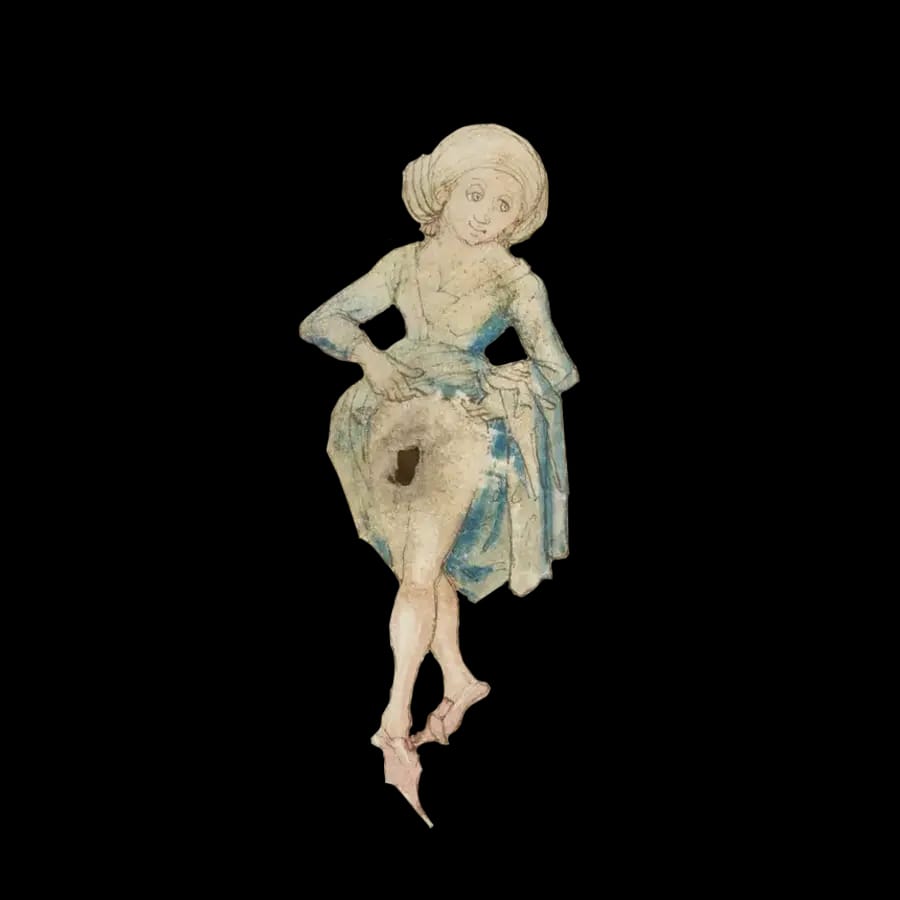
In his drawings, Urs Graf depicts women whom he, as a mercenary, might have encountered in war. He generally shows them accompanied by a man. In this drawing, the woman in the long dress is clearly marked as one who went to war — recognizable by her short overskirt hitched up high, with her dagger tucked ready at hand in the back of her belt.
The potential physical contact between the woman and the warrior — not yet realized, perhaps — is staged with tension through the figures’ posture and gaze. Here, Graf depicts perhaps one of the many women who saw an opportunity for income in wartime prostitution. For the Thirty Years’ War with its mass armies, the scholar Jan Peters coined the term ‘work-and-plunder couple’ [Arbeits- und Beutepaar]. Women are usually depicted accompanied by a man or by another woman.
The intimacy and closeness that could develop between the women accompanying the soldiers and the soldiers themselves on campaign have also been captured, in striking variety in Urs Graf’s drawings — regardless of the question of whether this closeness came about through free choice or through coercion.
Here we see three mercenaries on the shore of a lake; their companion hands them the bottle, while the dog in the left foreground sleeps deeply, its head buried in its fur. Its only visible eye, the right one, is closed — the marital fidelity the dog symbolizes has, for the moment, receded into the background. The three warriors are armed with two halberds and one long pike, as well as swords and daggers at their belts, worn above the codpiece. They were presumably meant to be standing guard.
Urs Graf depicts this one woman differently from the other camp women in his images. Here, the horizon is set much higher, at the level of the woman’s breasts. Graf’s drawing somehow seems to express respect and high esteem; the maimed woman appears proud, in spite of her somewhat averted, downcast gaze. Graf — and, with him, the viewers of the image — look up at her from below. In this way, Graf conveys a kind of respect toward the woman and evokes empathy. Unlike his other female figures, he lets her stand alone, without a male companion, lost in thought. We can only speculate about the causes of her lost limbs. They may have been due to new forms of artillery - cannons like Charles the Bold’s - yet Graf’s enigmatic drawing provides no clues about the woman’s past.
Power recast
Double dragon
Out with the old, in with the new! Sometimes even captured trophies were melted down so that more modern weapons could be cast from the metal.
The cannons of the Burgundian duke were large and important trophies of war, symbolizing the improbable triumph of the Confederates over a technologically advanced army. At the same time, a city needed artillery that was militarily operational and technologically up to date - and artillery technology was changing in this era.
Not terribly long after the Burgundian booty arrived in Basel, seized the opportunity to melt down and reuse material from outdated weapons. In 1513, it commissioned the casting of a new cannon called ‘Der Drache’ (‘The Dragon’). The weaponsmith Jörg von Guntentheim from Strasbourg was likely inspired by other Burgundian cannons. He created not merely a new weapon, but a second ‘dragon’ — one that referenced the “Burgundian lady” on display in the city’s arsenal.
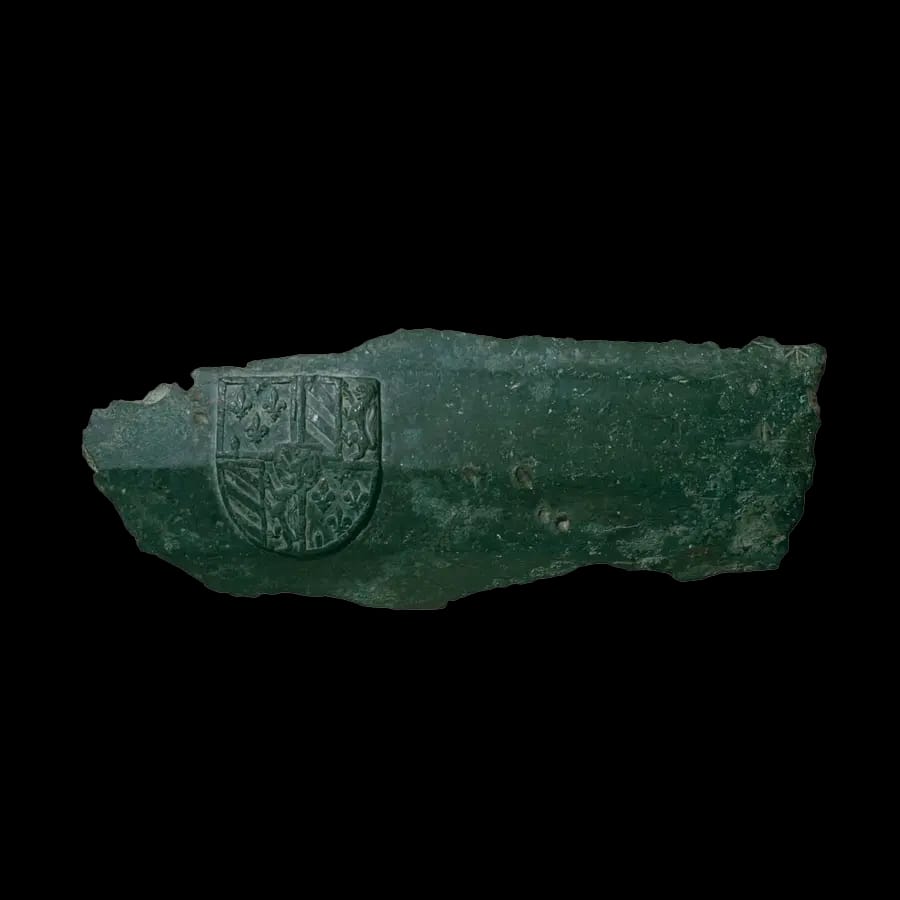
On von Guntenheim’s new cannon, the hexagonal elements of the barrel also protrude. Fragments of Burgundian cannons have survived that also feature hexagonally shaped sections, bearing Burgundian coats of arms. These are now in other Swiss collections — in St. Gallen and Bern.
Did a Burgundian cannon explode outside Bern? Bern was never besieged in the period following the Burgundian Wars. However, the ceremonies and theatrical presentations, or parades often took place in which old trophy cannons were fired. Perhaps the touch-hole chamber of the seventeen-sided barrel here burst during just such an event in the fields before the city? This would explain why it was later found in Bern’s Hallerstrasse, outside the ramparts and walls of the old town.
It was not, however, the people of St. Gallen who had captured this weaponl. The find site suggests, rather, that Confederates aimed the cannon — captured during the Burgundian Wars — against St. Gallen itself in a conflict in 1490, underscoring the tensions that belied the myths of confederate unity that were later spun around their defeat of the Burgundians.
The deployment of the Burgundian cannon, like the siege, was brief. The Confederates forced St. Gallen — an associate member of the Confederacy in its own right — to accept the sovereign rights of the Abbey of St. Gallen, the city’s rival.
The bell tolls, the cannon speaks
The sounds of both bells and cannons could announce impending danger or mark festive occasions. Both belonged to the late medieval and early modern soundscape, in war as much as in peace.
The inventories of the Basel arsenal suggest that the metal from bells and cannons was reused for the casting of both new bells and gun barrels. From Glarus, it is recorded that, following the battles against Charles the Bold, new church bells were cast from particularly large cannons. In 1856, one of these bells cracked. The subsequently recast bell bore the inscription: ‘Under St. Fridolin’s banner was I captured, in St. Fridolin’s church shall I be rung, God the Lord protect St. Fridolin’s land.’ This motto took up an old origin-story, and likely also the old engraving on the previous bell. The people of Glarus had marched into the Burgundian Wars under the banner of St. Fridolin. The city fire of 1861 finally destroyed the ‘Burgundian bell(s)’ for good.
Like the captured cannon in the Basel arsenal, bells too often spoke in the first person through their inscriptions. Their mottos could point to the origin of the material — from loot, for instance, in the case of new castings — thereby preserving or transforming the trophies and labeling them for posterity. At the same time, bells and cannons also spoke through their use, through their forceful banging and ringing. In the Schilling Chronicles, the Burgundians are frequently portrayed as making lots of noise. The Confederates, by contrast, are presented as a silent, stoic, powerful presence.
The ringing of newly cast bells - made of transformed weapons like cannons - carried a similarly important symbolic weight. Threatening Burgundian cannon shots could morph into the pious pealing of Glarus church bells, and the commemoration of victory within the Glarner’s church.
Cannons and canon
Cannons in the nave
In Basel, as in Bern and Zurich, objects from the Burgundian booty belonged to the core holdings of the city’s historical museum, founded in the 19th century.
The newly opened Historisches Museum staged a gallery of glory made up of captured objects including Jean de Malines’ cannon. These were arranged like a triumphal procession. The display emphasizes the abundance of weapons and trophies, meaning that in spite of its size and symbolic importance, Charles the Bold’s gun barrel gets a bit lost amidst the profusion.
At the turn of the 20th century, these display conventions continued to hold sway, presenting the Burgundian booty among a compilation of battle trophies to promote a nationalistically charged, imagined history of the Swiss nation (only founded in 1848) as part of a shared glorious past claimed as a common identity. This ideologically infused identity posited itself as autochthonous, but was constructed through objects taken from elsewhere.
Weapons as art in the museum
The Burgundian booty was a highlight of the newly built Historisches Museum in Bern (1894). These objects were prominently displayed, in the martial tradition of an arsenal, in the central hall of the first floor.
The Burgundian booty was the centerpiece of the newly built museum in Bern. The city hoped that the new building and the extensive collection of treasures like those from Burgundy would help Bern win the contest for the right to establish a national museum. Instead, the nod - and the new national museum - went to Zurich.
Half a century later, part of the triumphant military display was moved from the first floor gallery to one floor below. A dramatic staging at the museum’s entrance greeted visitory with a baroque Hercules swinging his club and three cannons. This staging responds tacitly to the Second World War, which was raging beyond the country’s borders at this time.
In 1967, the cannons were displayed in a temporary exhibition at the Bernisches Historisches Museum alongside oil paintings (portraits) and the elaborate Burgundian tapestries. The guns were framed here as art.
Art and cannons
With a few exceptions, military objects now play a marginalized role in museums even though historically they contributed significantly to the constitution of cultural heritage.
In Basel’s Historical Museum, as in many others in Switzerland, a new emphasis emerged in the postwar period. Military history was played down in favor of new cultural narratives, and military objects was frequently moved into storage or the museum basement, where it came to play a literally subordinate role. Today, however, museums are experimenting with new forms of exhibition-making that frame this history (and heritage of looted objects) differently.
In the Historisches Museum Basel, the Burgundian cannon l is presented together with other spoils and weapons from the Burgundian booty, next to the reconstruction of an early modern Kunstkabinett. This serves as a reminder that plundered objects, art objects, and scientific objects were once part of the same historical collections. It was only in the 19th century that art, history, and science collections were separated into different museums. Does the juxtaposition of the Burgundian booty and the Kunstkammer display (which traditionally included art, scientific, and military objects) point both backwards to a time when such collections coexisted, or does it point forwards to the future separation of these objects?
In a temporary exhibition on art at the court of Charles the Bold at the Bernisches Historisches Museum, subtitled ‘Splendor and Fall of the Last Duke of Burgundy’ (2008), the provenance of the collection pieces as Burgundian spoils was not concealed, but rather explicitly explained. Here, ‘art’ and ‘war’ were narrated as part of a single, unified history.
In the most recent presentation of Burgundian booty at the Bernisches Historisches Museum (2026), “The Battle of Murten: Staging a Victory” at the Bernisches Historisches Museum (2026), objects from the Burgundian spoils held by the museums of Zurich, Basel, Bern, and others are once again brought together, in a deliberate allusion to the triumphal presentations of old arsenals. This mode of presentation consciously interrogates the historical narratives bound up with shifting historical forms of display of these looted objects. This effort highlights the crucial role of violence in the formation of cultural heritage, a historical heritage many would prefer to forget.