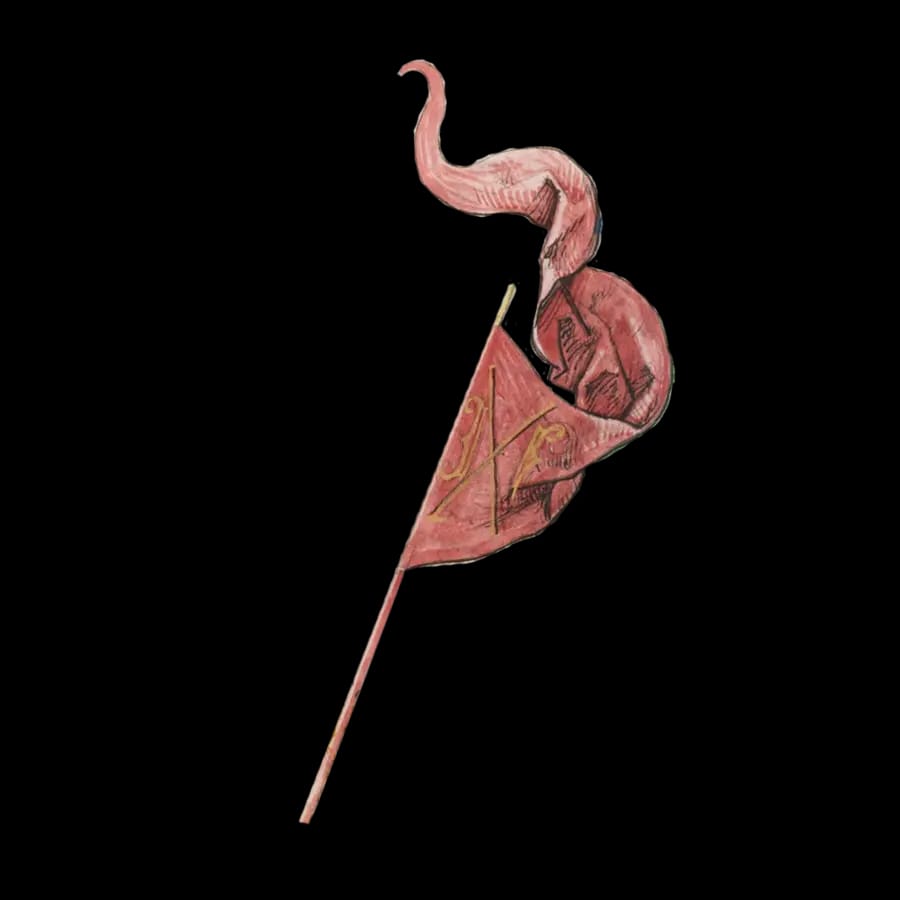
Captured flags - objects of honor
Flags and honor
In the medieval and early modern world, flags embodied important figures on the battlefield and in public spaces — like the Burgundian dukes.
In the medieval and early modern periods, flags (Fahnen) were important symbols of identity. At civic events, they publicly announced to everyone present who was in attendance. On the battlefield, they served to organize troops: soldiers were required to assemble beneath their respective flag. In this way, flags became symbolically charged and highly prized objects, often made from glittering silk and sparkling metal thread, as in the case of the Dukes of Burgundy. The shimmer of these flags, fluttering in the wind, heightened the aura and radiance of the Burgundian ruler and his retinue. They were physical embodiments of grandeur.
Both on the battlefield and in images such as Diebold Schillings “Berner Chronik” flags made events legible, allowing soldiers and readers alike to follow what was happening.
Flagging Humiliation
Flags symbolized not only identity, but also served as markers of triumph and defeat.
Flags and banners played an important symbolic role in the late Middle Ages in representing power relations. They could serve, for instance, to announce festive processions, or to demonstrate harmony between the populace and their rulers when flags were raised side by side. Conversely, the handing over of flags after a conflict symbolized humiliation and defeat.
An ambivalent image in the Berner Schilling shows the Confederates stealing flags and other valuables from Charles the Bold’s wooden house — items they had themselves given to their ally, the Duke of Lorraine (Herzog von Lothringen) after the victory. The boundaries between humiliation, triumph, and greed were not always clear-cut.
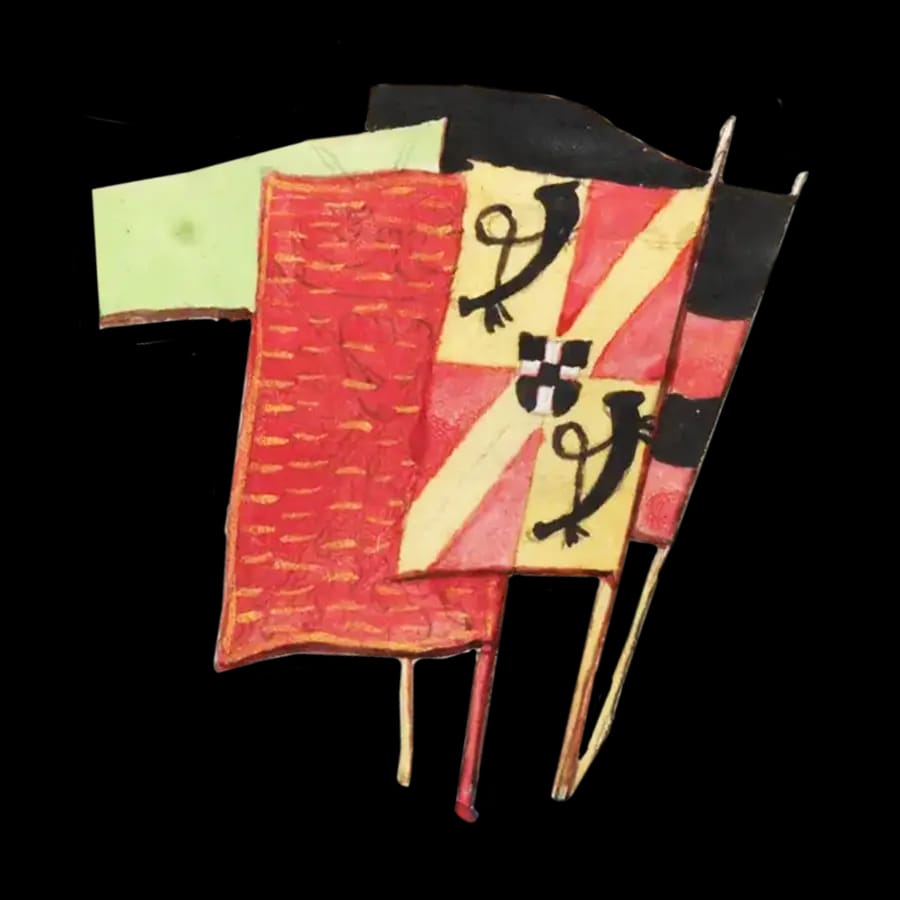
Praying Under Plunder
Sacred Victories
The Confederates hung the flags that they captured on the battlefield in their churches where they became quasi-holy objects.
When the Confederates captured flags on the battlefield, they hung them in their churches. God had granted them the victory and captured flags marked divine blessing. From military field-signs, the Confederates thus transformed captured flags into sacred trophies. Annual commemorations of particular battles (“Schlachtjahrzeiten”) were occasions on which the community could connect itself with the heroic deeds of its ancestors — ancestors who had defeated a common enemy and brought his flags home.
The Basel chaplain Johannes Knebel reported that after the Battle of Murten in 1476, ‘the people of Basel returned full of joy […] by the grace of God, and they brought with them their swallow-tailed banner, as well as another, golden one […] and they all entered the Basel church and knelt down — especially the standard-bearers and knights — on the steps in the middle of the choir before the altar, and gave thanks to God, the Holy Virgin Mary, and the 10,000 Martyrs for this wondrous and great triumph and victory, which had been granted to them from heaven.’ Such rituals strengthened the cohesion of the community and conveyed a sense of shared historical consciousness. In Zurich, a large portion of captured battle flags hung in the Wasserkirche. It is unclear, however, whether the Burgundian banners were among them.
Staging History
At “Schlachtjahrzeiten” [annual battle commemorations], accounts of battle victories and the names of soldiers were read aloud in church, keeping the memory of past triumphs alive for the assembled congregation. At these events, narratives of communal victory were propagated and idealized. The flags hanging from the ceiling were like relics — bloodstained mementos of the ancestors’ hard-won victories that lent proof to the stories being celebrated.
The flags were public symbols that made history tangible and present. When accounts of the battle were read aloud from the pulpit, the assembled congregation could vividly imagine the battle and commemorate it by listening and by looking at the flags. These ceremonies sometimes formed the basis for later illustrated historical works — so-called chronicles written and illustrated by Diebold Schilling and others.
When captured flags were presented in churches and stories told with them, narratives of friend and foe became easier to articulate: ambiguities could be erased in favor of clear definitions and differentiations.
Singing together
The victories at Murten and Grandson were immortalized in songs and passed down for generations, carrying a simple message that united different voices through shared lyrics.
Alongside commemorative services in churches, songs were a popular way of celebrating the victory over the Burgundians. Veit Weber’s song about the Battle of Murten, for instance, conveys a simple message that unites different voices. Weber ‘s lyrics describe local flags coming together and singing could likeiwse unify different localities without their losing their autonomy. This was key for the Confederates, for whom local identities were so important to maintain. For them, flags — much like polyphonic melodies — were an effective means of cultivating local patriotism while still recalling a collective victory, despite political divisions. Weber’s song was passed down not only through chronicles, but also later through printed broadsides and other mass-media.
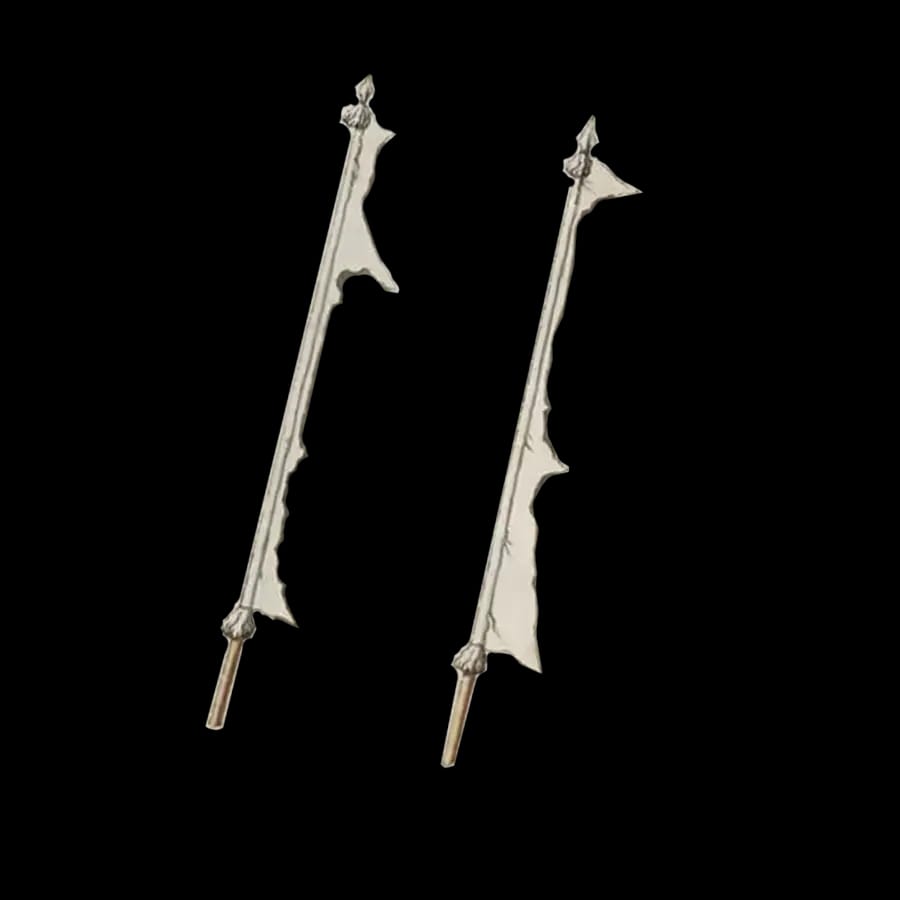
Fragile fabric memories
Things Fall Apart
Flags fall apart quickly. To preserve the memory of these trophies, the Confederates began to make copies of the banners they had captured.
Damaged on the battlefield, hung in churches exposed to air and light: the life of a flag was short. And yet these fragile objects were immediate testimonies of battles won, and material bearers of historical memory. The Confederates therefore began making copies. Some copies were replicas in fabric (often less expensive materials than the silks and metallic embellishments of the originals), but flags were often also drawn and recorded in flag books, known as “Fahnenbüchern.” In this two-dimensional form, they were sometimes shown in motion, sometimes laid out flat as flat emblems. This translation into the medium of drawing thus made it possible to preserve fleeting memories made of fragile fabric.
In Zürich wurden die Fahnen im Zeughausinventar abgemalt. Diese Kopien vermitteln dauerhafter als die Originale, wie die nun zerfallenen Fahnen mal ausgesehen haben können. Hier finden wir unter anderen Zeichnungen von dem “Panner” Karls des Kühnen.
In Luzern hingen die erbeuteten Fahnen in der Franziskanerkirche. Im 17. Jahrhundert wurden sie in einem Fahnenbuch abgemalt. Das Fahnenbuch diente als Vorlage für weitere Kopien. Zuerst wurden die Fahnen an den Kirchenwänden gemalt. Später ersetzte man sie durch bemalte gewölbte Holztafeln, die den Eindruck erwecken sollten, dass die Fahnen in der Luft hingen und wehten. Man suchte stets nach Lösungen, um die Erinnerungskultur lebendig zu halten.
Working copies?
Fluttering Stand-Ins
One particular type of copy is now known as a Gebrauchskopie [or ‘working copy’] — these are copies made on fabric that could materially substitute for the original objects, even though they were not as elaborately decorated as the originals. At the Bernisches Historisches Museum, a flag attributed to Anthony of Burgundy has, since the 1940s, been labeled as one of these so-called ‘Gebrauchskopien.’
Unlike drawn reproductions of flags, fabric working copies could still move and flutter in the wind. In this respect, they retained important qualities of the ‘panners’ and ‘venli’ that had once been carried into battle.
Images distorted over time
Which memories are real?
As the captured flags disintegrated and the immediate memories of the battlefield victories faded, the damaged trophy banners began to proliferate in new forms. Various communities within the Confederacy had made drawings of their booty flags in books, as a historical register of their victories. Sometimes the flags were drawn in motion, others flat and almost two-dimensional. This translation into the medium of drawing made it possible to preserve fleeting memories made of fabric. These memories — and thus also their translation into a new medium — were, however, never entirely accurate.
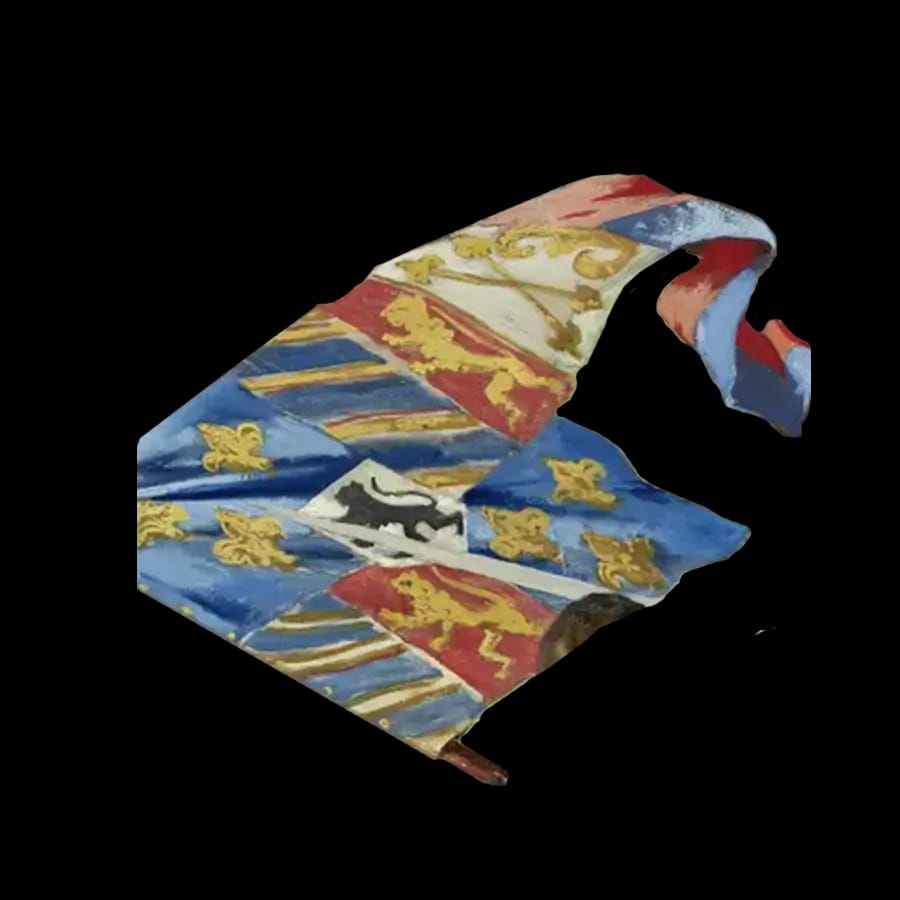
The inventories in the Zurich arsenal books show how distortions or deviations regarding objects such as the Burgundian banners were passed on. The Burgundian flag that is the focus here, for example, was already being depicted with rounded corners as early as the 17th century, even though it was almost certainly rectangular.
These copies of copies of copies — copies, that is, spanning multiple generations of replicas — raise the question: which memories are genuine, and how genuine are they, really?
Today, for instance, the Burgundian flag depicting St. Christopher survives in the National Museum only as a fragment like the other Burgundian flags still preserved in Swiss museums. As with the banner bearing the coat of arms of Charles the Bold, we today can only guess at what this object actually once looked like.
“In the Lucerne flag book, which was itself copied several times, we also find depictions of tattered flags. As banners, they can no longer be recognized as such, and yet they still appear as signs of hard-won victories and vanquished enemies. Sometimes fragments, too, can make powerful statements. From the fragment, new narratives and fictions can be spun.
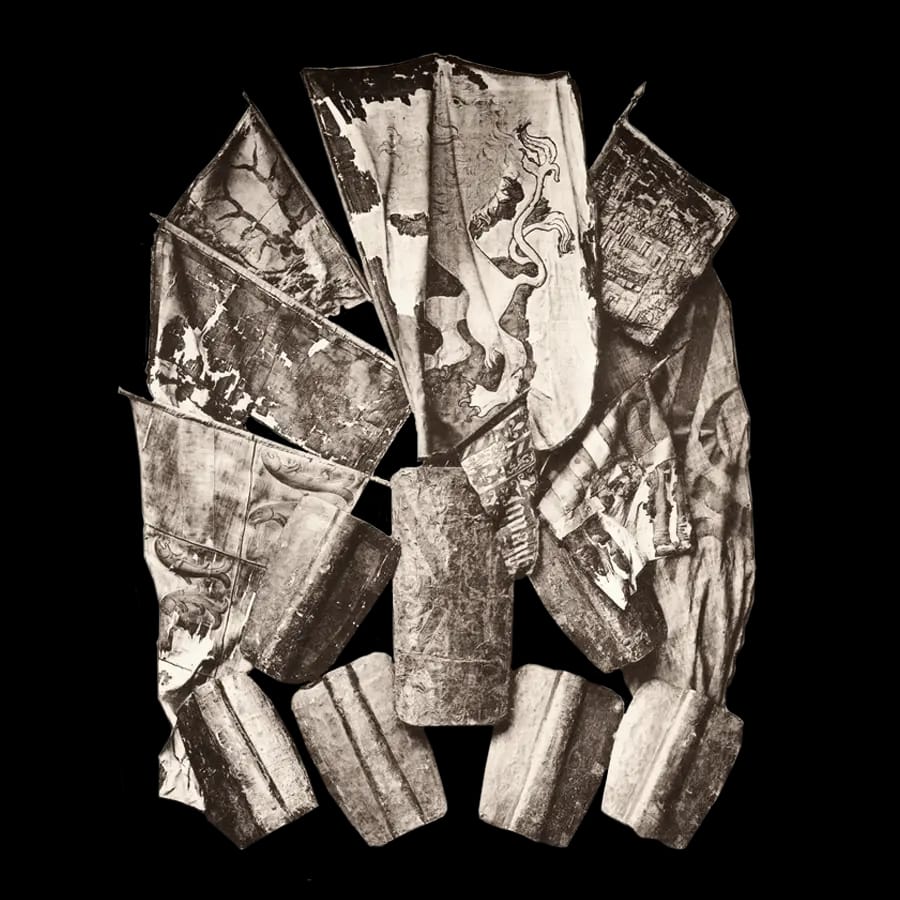
First church then armory and finally museum
“From church to armory: halls of fallen heroes?
In the 16th century, Zurich relocated its flags from the church to the arsenal, where they were inventoried, put on display, and kept in storage.
In 1528, the city of Zurich moved its disintegrating flags from the Wasserkirche. First they were put in special storage chests in the town hall, and then they were moved to the arsenal, where they were inventoried, stored, and displayed. Reformers like Heinrich Bulliger had been critical about keeping trophy flags in the church. Bulliger remarked, ‘It was also considered Christian, friendly, and sincere to display the signs visibly and even to let them hang publicly, whereby new resentments were stirred up daily.’ With the move to the arsenal, the flags acquired a new, secular and military context- avoiding stirring conflicts between fellow Christians in ecclesiastical space. Flag trophies, for people like Bulliger, were more appropriate for secular spaces if they were to be displayed at all.
The Zurich arsenal moved several times. This 19th-century etching shows the display in the armory hall at the Leuenhof. The exhibition at the Leuenhof, designed by the painter Ludwig Vogel — known for his patriotic depictions of Swiss history — was meant to inspire and enthuse visitors by bringing history vividly to life.
In the 19th century, the arsenal relocated to a new modern complex in Aussersihl. The Burgundian flags moved along with it and were displayed as trophies on the walls, in lavish fan-like arrangements.
Building national consciousness: museum as memory
In the 1880s, a rivalry broke out among Swiss cities over which city would build a new national historical museum, with Zurich ultimately winning out. The architect Gustav Gull designed the Swiss National Museum, (Schweizerische Nationalmuseum) which opened in 1898. The Burgundian flag now moved from the arsenal into the museum.
The centerpiece and affective crescendo of the museum’s design was the so-called Ruhmeshalle [‘Hall of Fame’], or Weapons Hall in which weapons, armor, and flags were displayed, commemorating the glorious achievements of Swiss military campaigns — among them the Burgundian Wars. In this way, an idealized version of history was presented, one that obscured internal conflicts within Switzerland between regions and confessions, for example. Old battle victories were displayed as something all Swiss could supposedly rally around.
Banners such as the Burgundian flag formed a central component of the display in the Weapons Hall, which combined elements of earlier arsenal exhibitions with a sacred architectural style — a reminiscence of the era when the flags still hung in the Wasserkirche.
Props for a panorama
Virtual Battle: Flags as Witnesses to the Battle in the Murten Panorama
In 1894, an giant panorama of the Battle of Murten, painted by Louis Braun, opened in Zurich. Flags made the depicted chaos of battle legible.
Louis Braun was one of the most successful panorama painters of his time. In 1894, his depiction of the Battle of Murten opened in Zurich. The panorama was a format that fully surrounded viewers. Braun researched historical objects such as flags in order to create historical credibility. Flags were important pictorial elements, since they allowed viewers to identify the actors in the fighting. Braun therefore made use of flag books in order to make his battle scenes appear both authentic and legible at once, even though many aspects of them were thoroughly imbued with fantasy.
A research group at Lausanne’s EPFL has now produced an extremely high-resolution scan of Braun’s panorama, allowing viewers to explore this highly mediated representation of history up close.

Unflagging national spirit
A nation of flag-wavers
At certain moments in history, renewed interest arose in captured flags — for example, in the 19th century, following the founding of Switzerland in 1848, when they were incorporated into historical pageants promoting a new national cultural heritage.
In the 19th century, lavish historical pageants became an increasingly popular means of cultivating affective historical narratives. Cities, as well as the newly founded nation, staged pompous historical shows with casts of hundreds in front of large audiences to foment a sense of shared cultural values. The Burgundian Wars were a frequent subject of these dramatic performances.
Elaborate costumes, as well as replicas of captured flags, were carried by the participants as a means of making an “authentic” past come to life.
Because flags were easily recognizable even from far away, they allowed a broad public to identify the actors within the historical drama. They also lent a fictional sense of historical credibility.
Even today, flag tossing remains a skill put on display at events like the 32. Swiss Jodeling Festival (Eidgenössische Jodlerfest) which took place in Basel in June 2026. Watching the flag-tossers, one gets a sense of the ways in which flags as objects not only became animated when they moved, but also demanded training to be handled with pizzaz.
Spiritual defense of the homeland?
Geistige Landesverteidigung (spiritual defense of the nation)? Swiss exceptionalism during WW2
“The 1930s brought a cultural impulse to distinguish Switzerland from Nazi Germany. The so-called Geistige Landesverteidigung [‘Spiritual/Intellectual National Defense’] sought to strengthen a specifically Swiss identity founded on shared ‘Swiss’ values that countered the threat of Nazi dictatorship. Some of these values were linked to the legacy of victories over ‘foreign tyrants’ such as the Burgundians and Charles the Bold, as if the brave blood of the Confederate ancestors would - or should - still inform contemporary actions.
“In this context, flags became a means of identity formation. They became part of books, postcards, and texts that conveyed Switzerland’s past victories to a broad public in a manner intended to be easily understood.
To store and to conceal
Reconceiving the postwar museum
In the postwar period, Swiss historical museums no longer regarded past military victories as a priority — quite the opposite! There were new stories to tell.
While in the 1930s, Swiss military history and the medieval victories over foreign powers were once again intensively propagated as national narrative, the postwar period turned instead to new stories and narratives about Swiss identity. In historical museums such as the Landesmuseum in Zurich, the impressive display of flags, cannons, and weapons that had been on view since the museum’s founding was scaled back.
“The trophy-like presentation of militaria gave way to a more restrained exhibition format. Neutrality, peace, and craftsmanship were now emphasized as Swiss cultural qualities. Banners that once fluttered were laid still. Was this move inspired by a desire to conserve the disintegrating objects or was it also a political choice?
Considerations in conservation
In the postwar period, flags were increasingly kept protected from light and air, which meant that they largely were no longer displayed.
“After the Second World War, most of the captured flags were placed in storage, in order to better conserve them, protected from light and air. They no longer stood at the center of museum narratives. These fragile objects, which for centuries had been part of public exhibition and public consciousness, now no longer played so prominent a role in Swiss cultural heritage. In this way, they were indeed better conserved — but they also disappeared from public life. Political priorities shifted and simultaneously the handling of fragile objects in museums also changed.
In the 19th century, attempts were made to ‘restore’ (“restaurieren”) the flags — that is, to bring them back to as complete and splendid a condition as possible. At that time, they were still proudly presented in museums, still hung in the display formats previously featured in city arsenals and churches.
“In the course of the 20th century, approaches to preservation changed considerably. Rather than creating a fictive wholeness, the past was now meant, in principle, to remain visible on the object itself. The professional vocabulary now spoke of ‘conservation’ (“Konservieren”) rather than ‘restoration.’ Conservation measures were meant to be reversible. At the National Museum, there was intense research and debate over which conservation methods should be applied to the flag collection. Should they be washed, to smooth them out? Should they be glued or placed under glass? Should the past still be allowed to actively flutter? Or is it better to keep the flags protected, but invisible? How should these sensitive collections be handled today — and in the future?

Caring for History: a gendered responsibility?
Fahnenbegleiterinnen - female flag bearers
Stories about Swiss military history revolve around men. But if we look more closely, we also find women — frequently accompanying flags.
The military sphere was an environment in which male identities were famously shaped and disseminated. But women were also involved in military activities and appear as well in word and image. Archival sources from Basel even report on women who were active on the enemy’s side at Murten. Frequently, women were depicted in late medieval Swiss chronicles accompanying male troops as standard-bearers. The status of these women, however, is barely known.
Who were these women, who marched with flags? This drawing by Swiss soldier and artist Urs Graf highlights the ambiguous status of women and flags in the early modern period.
Menders of history
In Swiss historical museums, museum curators were, for the most part, men. Women were often employed to care for textile objects — including flags.
Women like Mechthild Flury-Lemberg became, in the postwar period, leading figures in the development of the field of textile conservation. This field remains, to this day, strongly gendered: the majority of textile conservators are women. These female specialists tend to the surviving remnants of Switzerland’s flag holdings. The preservation of this part of Swiss history thus lies predominantly in women’s hands — even though women play only a marginal role in the representations of Swiss military history. On the curatorial side, Jenny Schneider was the first ‘collections conservator’ (i.e. curator, as distinct from conservator) at the Swiss National Museum, starting in 1961. From 1982 to 1986, she further served as the museum’s director.