From royal hand to royal hand
Truly inherited?
The widowed queen appropriates the devotional panel (Andachtstafel) of the deceased king, takes it out of the country, and hides it in a convent in her homeland.
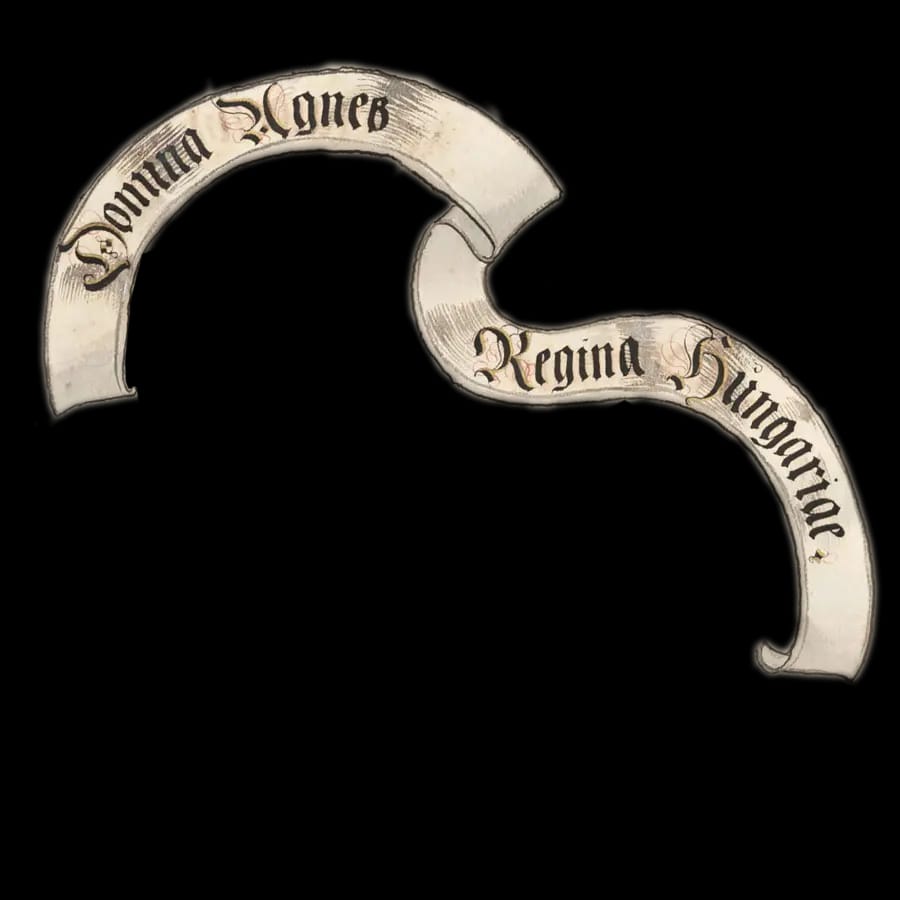
Agnes von Habsburg (c. 1280–1364) must flee Hungary for Vienna, to her family of origin, after the death of the Hungarian King Andrew III.
She brings her treasures to safety in the Augustinian monastery of Klosterneuburg. This presumably also includes the diptych that had been made for her husband.
Was the panel her rightful inheritance? Did she unlawfully take it? Or was she managing it in trust for her underage stepdaughter from Andrew III’s first marriage?

Royal treasures in a convent
Gifts for eternity
The donor family gives precious objects to the convent, trusting in the power of the nuns’ prayers.
A charter from 1357 lists around 220 objects that the Habsburgs had donated to the Königsfelden Convent for the performance of splendid liturgies. The charter forbids the sale, pledging, or alteration of any of these objects.
In the eyes of the founding family, the precious-metal liturgical objects and costly church vestments symbolized the glory of God; the relics of saints brought salvation in this world and the next.
Prayers were to be said for the founding family into eternity as thanks for the rich gifts they had donated.
The salvation of a murdered man’s soul
The wife and the eldest daughter of the murdered king played an active role in the founding and endowment of the Königsfelden convent.
The convent was founded on the exact spot where the German King Albrecht I of Habsburg was murdered.
Elisabeth of Görz-Tirol, his wife, and Agnes von Habsburg, his eldest daughter, devoted considerable wealth to furnishing the church handsomely.
Elisabeth donated the basic instruments and furnishings necessary for worshipping appropriately, while Agnes supplemented these with relics and valuable reliquaries as well as exquisite textiles.
Stolen stones?
Goldsmithing is also a form of investment. So who removed the now-missing gemstones, and when?
Around 200 precious stones, mainly jaspers and chalcedonies, originally adorned the panel.
About a third of these were lost over time, though we do not know if this was a gradual process or happened all at once.
Some stones were moves to new positions, along with their settings.
The pearls were all only likely added in a second phase.
The reasons for these changes, and their timing, are a matter of speculation.

Magnificent materials - posessions of power
Luxury from Venice
Venetian craftsmen were outstanding stone-cutters and produced sophisticated and magnificent objects.
In the thirteenth century Venice was a center for the production of pictorial works made with exquisite materials—ornamental stones from across the world, pearls, gold, and rock crystal. Book illuminations on parchment with gold grounds and colors were also incorporated into objects made by goldsmiths. These included both secular luxury products and objects made for divine worship.
The luxury goods were widely distributed. As exquisite gifts for princely courts, monasteries, and churches, they reached as far as the eastern Mediterranean and even the Caucasus.
Holy ancestors can come in handy
Power belonged to whoever possessed precious objects.
The pictorial program of the folding panel supported the claim of Andrew III of the Árpád dynasty, to the Hungarian throne. It highlighted his saintly lineage.
Around the outer edge, we find the holy royal ancestors, as well as the beloved Saint Elisabeth of Thuringia, a relative of Andrew III. The apostle Andrew, the king’s name patron, is also depicted.
Secularization ###nich etwas besseres?##
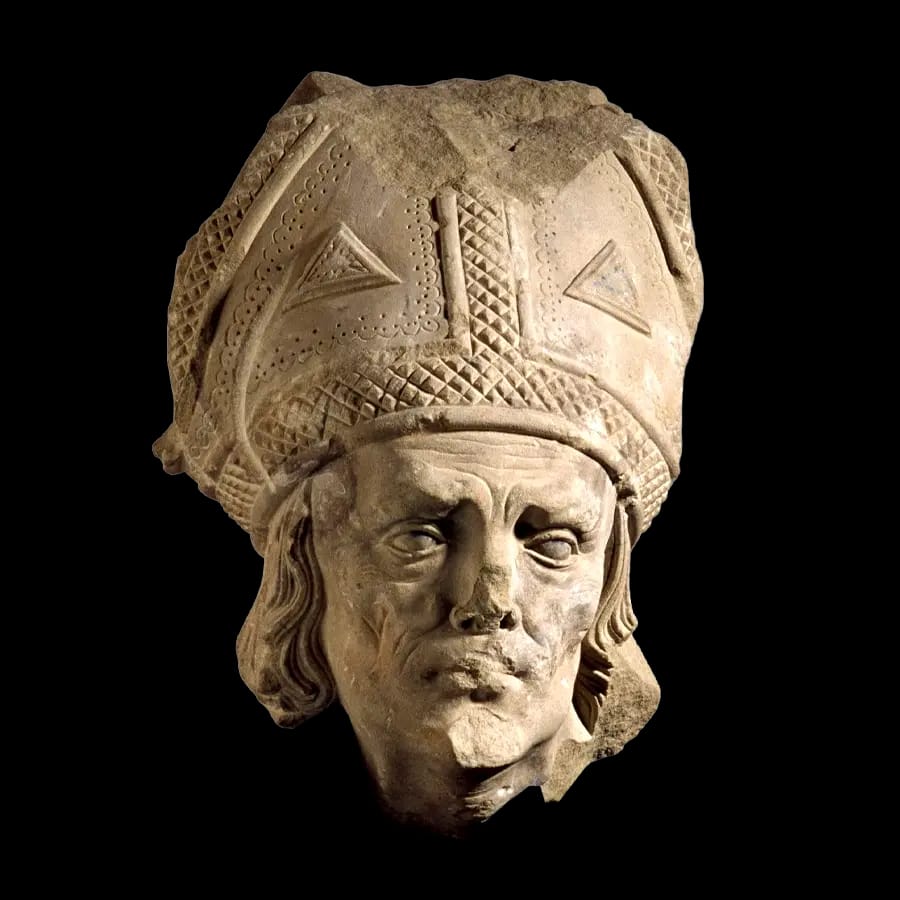
Bern decrees the true faith
The Reformation was a struggle over the “true” faith. This resulted in massive material destruction, the displacement of objects, and expropriations.
The profound changes in liturgy and the dissolution of monasteries in the Protestant regions of the Confederacy caused significant alterations in all areas of life: they were destroyed, displaced, and in many cases expropriated. Reformed theologians justified this massive breach of law by appealing to the Bible, arguing that images of saints distracted from proper religious practice.
Efficient expropriations
The authorities confiscated religious objects for ideological reasons.
In March 1528, the Bernese authorities decreed the dissolution of the convent in Königsfelden and prohibited the celebration of Mass there.
The Bernese convent bailiff ordered the church treasury to be secretly transported to Lenzburg Castle, which was under Bernese authority at the time. There, the treasury was recorded on a list that is now lost.
In March 1528, the entire convent treasury was transported to Bern.
A church treasury cashed in
In reformed Bern, ritual implements confiscated from the monasteries were melted down, primarily to mint coins.
On the authorities’ orders, goldsmiths reworked the ecclesiastical implements.
They separated the gold and silver and melted them into silver and gold bars for coin minting. This served a dual purpose: the implements of the old (Catholic) faith were destroyed and rendered unusable, while the silver thus obtained could be put to social use, in the form of money, for purposes such as feeding the poor and the sick. At least 32 kilograms of silver were recovered from the melted-down objects from Königsfelden.
Why not destroyed?
A few individual pieces escaped the reformed destruction and were instead incorporated into the state treasury. Who, one wonders, made that decision?
A few outstanding objects from the Königsfelden monastery treasury escaped destruction. They were brought to the town hall and kept there.
By the mid-sixteenth century, these pieces had apparently already been recorded on a list, though this list has not survived. We do not know who advocated for their preservation. Is it mere coincidence that they are, without exception, works of extraordinary craftsmanship? Or did the decision-makers deliberately select the most skillfully made objects?

The field altar of Charles the Bold
Devotional panel or book?
In the Bernese cabinet of art and curiosities the painted panel from the women’s convent was displayed as property of Charles the Bold.
In 1696, the diptych was transferred from the town hall to the city library. From then on, it was displayed there as an attraction alongside other artful works (“artificia”).
The diptych was said to be the field altar of Duke Charles the Bold and to have been part of the Burgundian booty.
New layers of meaning were applied to the Venetian panel: it became a testament to the highest artistic quality, since the court of Charles the Bold had set the artistic standard of its day. At the same time, it became a symbol of Bernese military success, since the Bernese had captured this personal property of the duke as spoils. The Venetian and Habsburg heritage of the object were erased.
Loot in the library
Books, minerals, taxidermied animals, ethnological artifacts, archaeological finds, as well as spoils of war were catalogued and put on display.
A new building was built to house the library in 1775.
Paintings and books were arranged on the elegant upper floor, while the remaining collections were densely packed on the ground floor: natural history specimens (minerals, fossils, and preserved animals and plants), archaeological finds, and “ethnographica.”
The field altar of Charles the Bold remained a centerpiece of the collection; in 1827 it was said “to be of Byzantine origin.” It was displayed alongside Arctic clothing from Canada, Persian slippers, and archaeological weapons.

Under the auspices of science
Repatriation through research
A Catholic priest in Reformed Bern revealed certain long held assumptions to be wishful fictions.
Jakob Stammler ministered to Bern’s small Catholic congregation and researched the local medieval museum collections. As a practicing priest, he understood the sacred functions of medieval objects better than local Protestant scholars.
In this way, he demonstrated that many objects previously regarded as Burgundian booty actually came from confiscated medieval church treasuries.
The “field altar of Charles the Bold” was made in Venice and came to Bern together with the treasury of Königsfelden. It had nothing to do with the Burgundian duke.
Refuse reveals hidden origins
The theologian Jakob Stammler identified the provenance of an altar hanging (antipendium) on the basis of the recycled medieval parchment that had been used as stuffing underneath the figures.
Maria Mürset restored an altar hanging at Bern’s Historical Museum and uncovered medieval parchment that had been used as filling material: a charter and fragments of a liturgical manuscript copied in a convent scriptorium.
Having identified the charter, Stammler deduced that the antependium had come from the Königsfelden convent. Like the diptych, the textile had previously been attributed to the Burgundian booty. The parchments that were removed during the restoration were then lost inside the museum for more than 100 years.
X-ray visions
A mobile X-ray device scanned the diptych and revealed crude iron nails.
Researchers had assumed that the right and left sides of the folding panel had been switched at one point.
That, however, is not the case. An X-ray image from the Institute of Forensic Medicine at the University of Bern shows that the hinges between the panels were never altered. They are set deep into the wood.
The long nails fixing the frame moldings to the base panel at top and bottom are also very striking. This is not visible from the outside, since the nailheads were carefully countersunk and concealed.
The digital twin still lacks the luster
Something is missing from every copy. For example, a scanning robot cannot yet perfectly replicate the sheen of the goldsmith’s work, no matter how hi-resolution technology becomes.
The latest 3D technology often produces astonishingly realistic results when it is used to imitate and reproduce historical objects. Such copies can be useful for scholarly research and documentation, and are sometimes also used in exhibitions—for instance, when the originals are too fragile to be shown or transported. In spite of advancing technology, however, the reproduction of shiny, smooth metal surfaces remains technically extremely difficult.
The results from a scanning robot are not yet fully satisfactory.